
Spend enough time in sci-fi fandom and you’ll eventually be expected to take a side: is Star Wars science fiction or space fantasy?
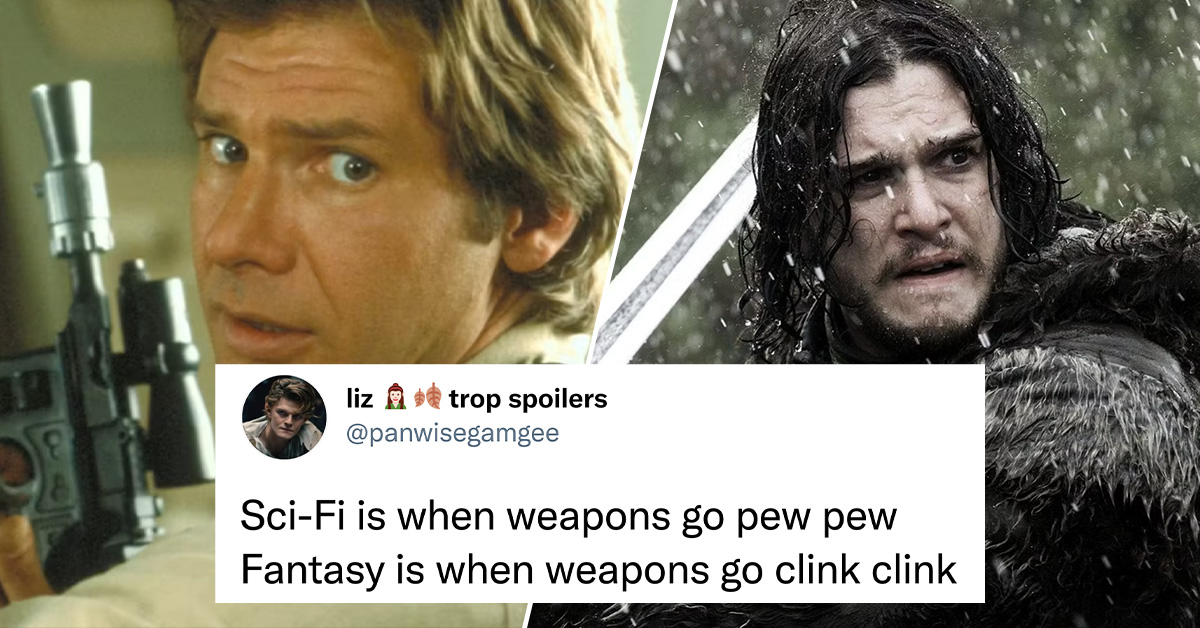
The usual argument against including Star Wars in the hallowed halls of science fiction is “because space wizards.” However, then we have to define what “space wizardry” really is, because there’s nothing that the Jedi do that can’t be framed as ESP or psychic powers in other settings that don’t get this kind of pushback. And if we’re going to disqualify any story with vaguely-defined psychic powers, then we’ll also need to remove Star Trek, Dune, Babylon 5, Battlestar Galactica, and more.
The less-common, but still notable, objection is that it just doesn’t depend on science fiction tropes. It has spaceships and robots and other planets, but they aren’t central to the plot the way the starships of Star Trek or the titular space station of Babylon 5 are. That centrality is instead given to “space wizardry.” But, in addition to bringing us back to the question of how much ESP is too much for sci-fi, this argument overlooks the opposite issue: does putting a spaceship in a dragon-rider setting make the spaceship fantasy? Or does it make the dragons some form of science?
As you might guess, I have some thoughts on this topic, enough for more than one blog post. I’m going to go through the arguments as I see them, look at the development of the genre, offer my own definition, and even spend time on the question of soft versus hard science fiction. But, first, there’s an even more important question: why should we even care?
Continue reading

Why I’m No Longer Recommending Tuscany Press to Authors
EDIT: Since posting this yesterday, several people have privately told me of more issues with Tuscany Press. Some of it has been anecdotal, but others have been verifiable; and it all adds up to an unpleasant picture. The editor-in-chief at Tuscany has told me that the essay I fisked in the following post is opinion and should not be construed as Tuscany’s stance, but he did not address the issue that it was approved by Tuscany despite being obviously wrong. I may do an update on this issue soon.
ANOTHER EDIT: I’ve posted an update on this situation here.
Tuscany Press has been my go-to publishing house to recommend to fellow Catholic authors. I’m associated with Chesterton Press, a smaller indie Catholic Press (my Novel Ninja business is separate and not exclusive to Catholic fiction), but Tuscany is a larger operation and can handle more submissions at a time. However, I’m no longer recommending them, due to a recent post on their subsidiary, CatholicFiction.Net, on why science fiction is evil. Continue reading →
Share this: