
Spend enough time in sci-fi fandom and you’ll eventually be expected to take a side: is Star Wars science fiction or space fantasy?
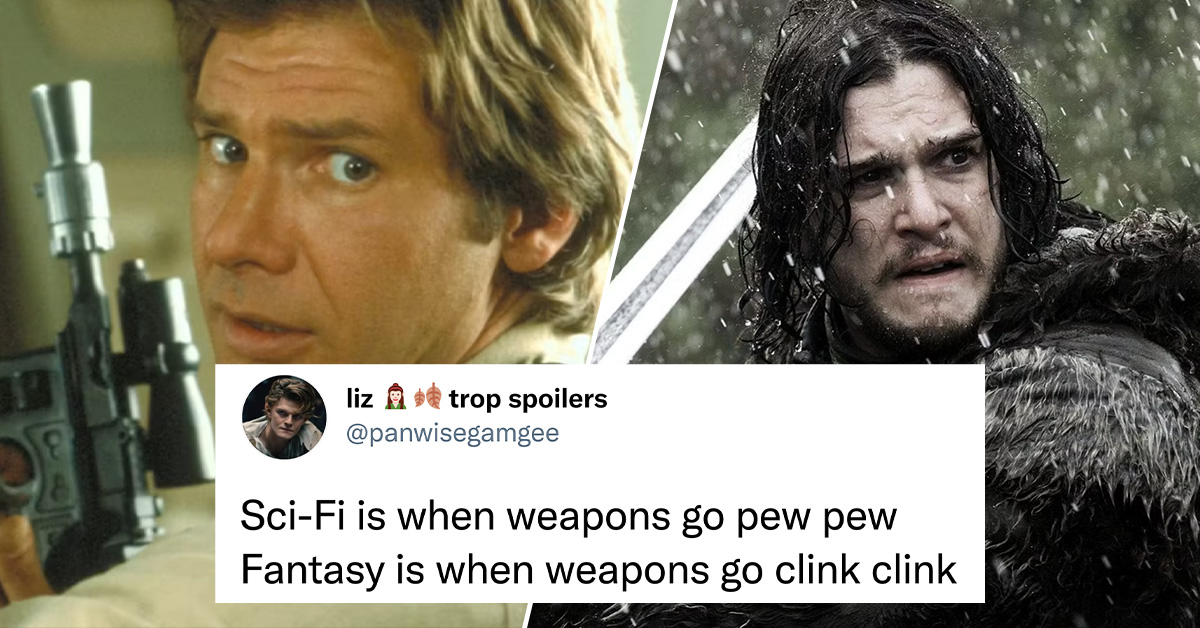
The usual argument against including Star Wars in the hallowed halls of science fiction is “because space wizards.” However, then we have to define what “space wizardry” really is, because there’s nothing that the Jedi do that can’t be framed as ESP or psychic powers in other settings that don’t get this kind of pushback. And if we’re going to disqualify any story with vaguely-defined psychic powers, then we’ll also need to remove Star Trek, Dune, Babylon 5, Battlestar Galactica, and more.
The less-common, but still notable, objection is that it just doesn’t depend on science fiction tropes. It has spaceships and robots and other planets, but they aren’t central to the plot the way the starships of Star Trek or the titular space station of Babylon 5 are. That centrality is instead given to “space wizardry.” But, in addition to bringing us back to the question of how much ESP is too much for sci-fi, this argument overlooks the opposite issue: does putting a spaceship in a dragon-rider setting make the spaceship fantasy? Or does it make the dragons some form of science?
As you might guess, I have some thoughts on this topic, enough for more than one blog post. I’m going to go through the arguments as I see them, look at the development of the genre, offer my own definition, and even spend time on the question of soft versus hard science fiction. But, first, there’s an even more important question: why should we even care?
Who Even Cares?
This isn’t actually about whether Star Wars is science fiction. If it were just a matter of settling an Internet argument, I would skip it. However, there’s an important factor for authors to consider: namely, that genre is marketing.
Genre has very little bearing on how you write. Your genre doesn’t limit what you can tell a story about. What it limits is how your audience will shape their expectations. Take the concept of the dragon-rider setting with spaceships: The Dragonriders of Pern starts out feeling like low fantasy (medieval setting, dragons) but it soon becomes clear that their ancestors had a great deal of technology that has since been lost. After several books, the truth is revealed: it’s a science fiction setting, Pern is a colonized planet, and they got there in a spaceship.
The Dragonriders of Pern is an SF classic. Its near-fantasy vibe turning to clear post-apocalyptic-SF is one of its enduring virtues. It also makes it a difficult thing to market, especially to today’s audiences. Without careful framing, that dragon-riding theme tends to attract readers who don’t want the science fiction elements, just the fantasy setting.
For a more recent example, Larry Correia pitched his publisher an alt-history trilogy deliberately arranged to fit all requirements for epic fantasy. His publisher said no. Not as a refusal for the story, but no on the marketing. What he was pitching was alternate history superheroes, and it got published as The Grimnoir Chronicles. Same story, vastly different audience. Even those who would read both genres might get completely thrown by the story if it were sold differently.
This is why I want to spend so much time on the topic of what, exactly, is “science fiction.” Why I want to make certain the definition I use, that I have used for over eight years now, was based on how the audience sees it. Because ultimately it doesn’t matter what a few people arguing on the Internet say it is. The opinion that matters is that of the people who might buy your books . . . or might not, because they think it’s something else.
So What Is “Science Fiction”?
There’s a simple definition attributed to Samuel R. Delaney: Realistic fiction could have happened; fantasy could not have happened; and science fiction might happen some day.
However, there are multiple problems with this definition. For one, anything labeled “hard science” and completely based on real physics would have to be “realistic fiction.” Second, there are plenty of clear examples of sci-fi where impossible violations of physics happen, which under this definition would mean they’re fantasy. And finally, if science fiction is simply stuff that might happen one day, we would have to include near-future thrillers even when based entirely on current technology.
So let’s take a page from ancient and medieval philosophers and lean on the common definitions rather than anything esoteric. This is the principle that when looking for what a word or term means, we must first look at how it is used. So — what is the first science fiction story? What started the trend?
This is where we run into a different binary argument. Once you start seriously discussing the topic of what counts as science fiction, two loose schools of thought emerge. I’m going to dub these the Trope school versus the Conceptual school.
The Trope school views things from a kind of presentism, saying that anything that resembles current science fiction tropes — such as space travel, underwater ships, thinking machines, and so on — is itself science fiction. This would therefore include the automatons built by Hephaestus in Classical mythology, the apparent rocket ship in the Sanskrit Rigveda, and the extraterrestrial civilizations in the Greek satire True History.
The problem with this, however, is that it is easy to look back at myths and folklore and euhemerize them — that is, to apply present knowledge to come up with an idea for a more mundane basis for the story. Gods were just ancient heroes put on a pedestal; monsters were just misunderstood animals or humans with a skin condition. This can show up in science fiction, but it obviously is not the definition of sci-fi as seen in common use.
I’ll define the Conceptual school as being based on the core concept of “science fiction” as a phrase: that it is necessarily fiction based on science. As such, it should be younger than science itself — or at least, the modern understanding of science as distinct from natural philosophy — and therefore the earliest examples of science fiction would have to be speculation based on the principles of physics, biology, and engineering.
I won’t pretend to be neutral on this. I’m firmly on the side of conceptualism. Either way, no matter what school you adhere to, it cannot be denied that the genre only rose to prominence, and was later defined, in the context of mechanization and the Industrial Revolution. If we define science fiction by its tropes, then we not only have to assume that anything can be science fiction if you squint hard enough, but also that there is nothing to unify science fiction except fads of the moment that continually redefine the genre. But if we base it on the concepts of science itself, then we can clearly see that the earliest examples of science fiction are centered on inventors and the innovative use of technology and scientific principles.
A Brief History of Sci-Fi
We see in Mary Shelley’s Frankenstein (widely considered the first science fiction novel — sorry, Trope schoolers) an inventor reanimating a corpse using electricity, a concept based on real studies of the time.
In Edgar Allen Poe’s The Unparalleled Adventure of One Hans Pfaall, we see this borrowing from real-world science taken to a new level, with a trip to the moon described in scientific detail . . . well, for his time; the science described in the story is absurd in light of modern knowledge, but Poe was of course unaware of that and I, for one, am much more interested in how he framed the story than in getting the science correct. Poe’s novel was explicitly referenced by Jules Verne in his own From Earth to the Moon, and Verne also dubbed Poe the originator of the “scientific novel.”
(While this could easily be seen as a snub of Mary Shelley, I find myself somewhat charitable toward Verne on this point for one particular reason: even if he had read Frankenstein at that point, Poe’s story attempted to maintain a scientific air for the entire story, while Shelley was far more interested in using science as a jumping-off point to explore aspects of human nature. So while I wholeheartedly agree that Frankenstein was the first science fiction novel, I can accept, for the sake of argument, that Poe wrote a novel that explored scientific principles on a level Shelley did not. However, Shelley did much more to explore the consequences of technology, as well as the ethics of scientific experimentation, which are both still a very strong concept in science fiction.)
Verne himself is considered the “grandfather” (or sometimes “godfather”) of science fiction, due both to his large number of works but especially due to his desire to get the details right. Not content with just making it sound scientific, as Poe did, Verne did his best to use only known physics and engineering, or direct extrapolations from the same without completely new elements. That legacy is a pretty solid one, as many of his speculations wound up becoming true . . . or at least rhyming with the truth.
Verne was particularly critical with H. G. Wells, saying “I use physics; he invents.” Like Shelley, Wells wrote books that took broad concepts and then used them to explore humanity rather than the universe. Here we can see the first split in the genre, even before it was codified: the hard science of Verne versus the soft science of Wells.
But there was plenty demand for soft science fiction, and the next big name to come along was none other than Edgar Rice Burroughs, author of (among many others) A Princess of Mars and its sequels. These books could be considered the first space westerns; in fact, A Princess of Mars explicitly starts as a western, which was possibly the most popular genre in the early pulp era — in the United States, that is, if not on a global scale. Those westerns were no strangers to the introduction of clear science fiction tropes, including robots, flying machines, and even the occasional ray gun; but Burroughs was the first to take it off-world, placing that western feel in a science fiction context rather than the other way around.
But it wasn’t until Hugo Gernsback that we had the first true attempt to define “science fiction” . . . even if the term itself hadn’t been coined yet. Gernsback (the namesake of the Hugo Awards, which I’ve written about a time or two) was an immigrant from Luxembourg who started a serial pulp magazine called Amazing Tales. He sought to gather together what would later be known as science fiction in one place. Amazing Tales was the first place anyone met Buck Rogers, and was the birthplace of space opera in the form of the story Skylark in Space.
John W. Campbell (the namesake of what used to be known as the Campbell Award, now the Amazing Award) took over Amazing Tales in 1937 and introduced the world to Isaac Asimov, Robert Heinlein, and A. E. Van Vogt. He took an active role in shaping science fiction as a genre, encouraging detailed worldbuilding, using brains over brawn, immersion rather than infodumping, and showing the consequences of changing technology. More importantly for our discussion, though, he encouraged authors to make their settings understandable in light of current scientific knowledge. He wasn’t the first, but he had probably the most lasting influence on the genre by convincing authors to take science fiction seriously.
A Working Definition
So with all that in mind, what can we use as a definition of science fiction? What can we draw on from these milestones in the history of the genre to find the common threads? Any definition must encompass not only the hard science of Verne but also the soft science of Wells; the adventure of Burroughs and Gernsback, alongside the intellectual characters of Shelley and Asimov.
Personally, I think the key is found in what Campbell encouraged: that science fiction must be understandable in terms of current scientific knowledge. Not necessarily letting real physics get in the way of a good story; but that if the majority of the audience understands a certain scientific principle, then it shouldn’t break that without explanation.
An excellent example, in my opinion, can be found in the reaction to Larry Niven’s Ringworld, a story that describes an impossibly large ring habitat circling a star, with the surface area of three million Earths, spinning to produce gravity almost equal to Earth. At some point I’m going to write a post about ring habitats, but suffice to say that Niven was well aware that the stress this spin would place on the structure was far beyond the strength of any known substance, so he invented the completely fictional material “scrith.” Soon after publication, fans got particularly vocal about how impossible the Ringworld was . . . but they didn’t care about scrith. Rather, their objection had to do with the physics of the habitat itself. Chants of “The Ringworld is unstable! The Ringworld is unstable!” literally followed him at one event.
I won’t go into why it was unstable; rather, I want to focus on why the readers felt cheated. They were fine with the invention of wholly fictional handwavium substances, but they took quite literal offense because Niven made a physics mistake on a topic he presented as being physically sound. The readers understood immediately that scrith was impossible; but they felt cheated because the rest of it violated the physics they understood even though the book was telling them otherwise. In effect, they felt gaslit.
Now of course, they weren’t particularly up in arms; it was all more good-natured than anything else. The point is that they expected the science, when presented as science, to be consistent.
So, after far too many words spilled, here is my definition of science fiction.
Science fiction is a genre where the story’s major points and setting depend on science and technology that is (1) not contradicted by the current understanding of the average member of the (original) audience, but (2) remains beyond the norm for that audience and/or the story’s time period.
Is this a perfect definition? No. I can still poke holes in it myself. However, I feel confident it is enough to cover most science fiction: soft and hard science, near future, far future, the typical alternate history settings attributed as science fiction, and even military thrillers using speculative technology.
. . . and yes, including psychic powers, because soft science is allowed. And they are, quite often, less impossible than a Star Trek phaser.


I love “how do you define” discussions, when folks actually want to have the discussion and fun rather than to ‘win’, because the zeroth question is “depends on why you’re defining it.”
For example, I could argue that fantasy themes use morality, while science fiction uses ethics. (To draw from a recent discussion about “fantasy is Christian”.)
I also think that “fantastic fiction” is a great over-arching term to get a general sort of notion, and that Frankenstein was techno-horror, not scifi. ^.^
But the whole point is to try to convey “this is what I mean,” turning stuff over and around to eyeball it closer, and the fun is in the trip.
LikeLike