Category: Writing Tips


Puppy Poetry

I’m not feeling well today (nausea, exhaustion, pain — basically, my fibromyalgia is being rebellious), so I haven’t been doing much of anything except lie down and hope it passes soon.

Sometimes, when I’m in the right mood and there’s something on my mind, I start composing poetry. I guess today’s one of those days. So, hey, I guess I’ve got another Hugo-related post in me after all.

While once upon a time a fan
Would know a Hugo would impress
In recent years awards began
To seem to lack that same success
Awards for excellence now went
To only those who would express
A social scheme without dissent
And jump on those who might transgress

The story, see, cannot be king,
Not if we’re to fix the mess
For social justice is the thing
And never style or finesse
The value of a tale is found
Only when its words address
A lack of tolerance profound
And so dissent we must repress

These are, we’re told, quite vital jobs
To let society progress
But it just left us with some snobs
Whose way of life was to suppress
This made many puppies cry
And seek a cure for their distress
The best of fiction they could buy
But Hugo wins would just depress

But then one year they tried as one
To get the field to reassess
The old idea that tales are fun
And that’s what Hugos should express
Canine plans weren’t met with glee
But rather lies told by the press
Yet puppies everywhere agree
That they’ll keep trying nonetheless!
The week isn’t over, but it’s just getting crazier. Aside from the “No True Fan” argument, publications like Entertainment Weekly (though the editors almost immediately retracted the hit piece), Salon, the Telegraph, the Guardian, and more, as well as numerous websites like Cracked and various blogs, have been saying over and over that the Sad Puppies campaign is vile, vicious, vulgar, and villainous. It seems that the campaign that nominated works by liberal, female, non-white, and gay artists did so out of a strong desire for a right-wing utopia dominated by straight white men. Who knew?

But I’m not going to get into that right now. I’m going to leave that up to others. For now, if you want my opinion on the subject, I invite you to look at my previous blog posts. In “Piers Plowman and the Hugo Awards,” I discussed the problem of putting a message before the story. I followed that with a look at those who argue differently, with “G. K. Chesterton and the Social Fiction Warriors.” Finally, after the Hugo ballot was released, I talked about the effort to deny the validity of opinions, and what makes a fan a fan, in “You Are All Fake Geek Girls.”

According to the trackbacks and referrals I’ve been getting, these are all considered moderate opinions, and as unbiased as someone who’s taken a side can get. I’m flattered, everyone, and I’m glad the posts have been useful.

However, unless and until more specifically writing-related topics come up, I’m leaving it there. I’ve been enjoying the extra traffic, but my focus here, on this blog, is on writing and reviews. I’ve said as much as I can really think of about that in relation to the Hugos.

. . . well, almost. I still have to get on to reviewing Hugo nominees. I fully intend to crank out as many reviews of nominated material as I can get before the end of July, when the final ballot is due. I already have non-spoiler reviews of Jim Butcher’s Skin Game (nominated for Best Novel) and Captain America: The Winter Soldier and The LEGO Movie (both nominated for Best Dramatic Presentation, Long Form).

But, for now, I want to talk about the voting process. Continue reading

EDIT: My apologies to anyone who got double emails and double trackbacks, or has had trouble with a broken link. The original version of this essay disappeared due to an infestation of drunk gremlins causing glitches. I had to rebuild it from the Google cache. If you are someone I linked to and have double trackbacks, I’m sorry for the minor bout of spam. One of those links won’t work now. 

I have an extremely pretty friend. Okay, that’s not unusual — a very high number of my female friends are good-looking, ranging from cute to gorgeous. This particular friend is drop-dead, traffic-stopping kind of gorgeous, with a smile that can stop hearts and a body that can cause accidents in the street. She’s a model, a singer, a dancer, a teacher, amazingly athletic, and huge fun to hang out with. Some of you know exactly who I’m talking about. A few times, it’s been suggested that we date. We both laugh.

Now, I don’t take offense at her laughter, not like I would from someone else. I mean, I’m a geek with a wheelchair; the only thing attractive about me is my brain and my paycheck. The latter is just big enough to be noticed and lacks at least two zeros as far as golddiggers are concerned; and the former, well, face it. It’s not enough. But I don’t find it offensive from my friend, because while we’re very close, we don’t fit well enough to even attempt a relationship, much less have a happy marriage. She’d have to go to her happy place if I start talking about anything other than where our interests coincide, which are actually in very few areas.

If you know me, you know I can’t possibly shut up about my interests. When I get invited to speak at conventions, I quite literally tell the panel coordinator to put me in however many slots he or she wants, because odds are I’m going to be talking to people all day anyway. I get a contact high from geekdom. The idea of even one date with someone who can’t stand to listen to me be enthusiastic about something is horrifying. I care for my friend like she’s family, and I’m there for her anytime she needs help, but we both know it wouldn’t be good for our friendship. So we both laugh.

Of course, the last time this happened, she threatened to punch me if I didn’t stop laughing. Sorry! But I couldn’t help it, considering the exact situation. But that’s beside the point. We’d both bore each other — even though we both deeply care about each other. Neither of us can be something we’re not.

This is why I hate it when people rail about “fake geek girls.” It’s also why I’m finding myself utterly perplexed to be called a fake geek girl.

Yes, I’m male. Bear with me. If it doesn’t already make sense, it will.  Continue reading

This weekend marks a particular event which pilgrims from all over the world have been waiting for. It’s a highly-anticipated event every year, and tomorrow evening, as darkness gathers, groups of the faithful shall come together, united by one desire.

I speak, of course, of the Hugo Awards nominee announcement. Easter’s the next day. Also, Easter involves less shouting, though admittedly it’s associated with at least one dead body.

The Hugo controversy is a hot topic every single year, and it’s only gotten louder in the last several cycles thanks to the campaign known as Sad Puppies. In case you missed my explanation from earlier this week, here’s a shiny and well-crafted link. That post details what the Hugo Awards are, why they matter, and how the controversy started. Or rather, the current controversy. As I said in that previous post, I was voting in the Hugos years ago, before I ever heard of this Larry Correia guy. Disputes happened a lot. That’s okay; I’d actually get worried if everyone was happy about the nominees.

The current dispute over the Hugo Awards boils down to this: books should be judged on their own merits, and good writing rather than ideology should win out. Any push for a book based on its politics, or the politics of its author, is to be treated with suspicion or even outright rejection.

The most interesting thing about this dispute is that both sides are saying the same thing. Continue reading

Language is one of those things that people tend to be concerned with when writing science fiction and fantasy (mostly in fantasy), and yet how many SF&F authors are linguists? It’s quite possible that this is a natural outgrowth of trying to show a radically different culture from our own; or it might be that the godfather of fantasy, J. R. R. Tolkien, the Professor himself, put so much work into his languages.

Not everyone is a philologist, though, much less one of Tolkien’s caliber. How do we use languages in fiction without sounding like we just made it all up? How can we make it up if we’re going to keep the audience from feeling lost? How can we even hope to show a language barrier if the book’s all written in English? Continue reading

When I was studying at Christendom College, I had to read a book called Piers Plowman. It was part of the core curriculum that all students had to study, a set of 24 separate classes (plus the math, science, and language requirements) that comprised the entirety of the freshman and sophomore years, as well as some of the junior year. This might sound a bit heavy, but it was actually very efficient and allowed a lot of information in both the lower and upper courses. All professors knew what their students had covered, and so little to no time was wasted on remedial material. This meant more in-depth study of a type normally seen only in graduate courses. With a few exceptions, we were rarely bored.

Piers Plowman was one of those exceptions. The only reason it isn’t a cure for insomnia is because of the torturous pain we suffered by studying it. In fact, in a student parody film based on 24, the villain tortures someone by tying him to a table and reading aloud from Piers Plowman. The actor’s screams were, no doubt, not entirely faked. Continue reading

Building Your World: Scale

When figuring out where to set your story, one of the simplest things to do is pick how far your story extends. Does it take place entirely in one town? Does it span an entire galaxy?

There has been an increasing trend toward larger and larger settings in the last few decades, though that trend may be reversing now. It seems as if, as our perception of our own world increases and our ability to get from place to place becomes easier, we seem to think that the same should be true even in a medieval fantasy setting. Lately, though, I’ve been coming across more and more stories that detail smaller areas, as if authors are realizing that — like with the real world — “flyover country” actually contains some interesting stuff. You can set a lot of stories in one small area.  Continue reading

Coauthored Books

CO_Authoer-ImageA lot of fans have dreams. Meeting their favorite author. Getting sneak peeks at an anticipated book. Getting two favorite authors to team up — oh, yeah, that’s one that will get people excited.
But that brings up a can of worms that might not be obvious at first look. Who’s ultimately in charge? If there are disagreements, how do they get resolved? Whose name comes first on the cover? If it’s not a 50/50 royalty split, why? And how is that determined?

This is something that shows up a lot in academia, because whomever shows up first in the list of authors has pride of place (unless possibly, but still often the case when, it’s just determined by alphabetical order). In a multi-author academic paper, the first name is not always given to the one who did the most work, but rather the one who will get the most notice and bring the most credibility to the findings. The last person on the list might well have been the one who did the lion’s share, but the first name usually gets most of the credit.

Unfair? Well, there’s a reason for this arrangement.  Continue reading

Some years back, I evaluated a manuscript for a publisher. It was a Civil War historical mystery novel, and the Civil War is not exactly my area of expertise. Yet I sent the chief editor seven pages of notes on the book’s historical inaccuracies and plot holes. The editor later told me that, while reading through those notes, she turned to someone else in the office and asked “Who is this guy, Sherlock Holmes?”

It remains one of the funniest moments of my editing career, because it really wasn’t that difficult to do. Almost all of the notes were things that were easy to research. The author had the days of the week wrong in reference to the Battle of Fort Sumter. The date of Easter for the same year was wrong by a month. Currency values were closer to 1980s instead of 1860s. The depiction of proper police methods felt more like Dragnet at times instead of a period when investigative police was a rare thing.

The one and only reason why what I did was unusual was that I’m a knowledge junkie. If I don’t know something, I still have a pretty good idea where to look it up. I have lists of experts to contact, on anything from astrophysics to horse care, from the history of international law to how to sew a dress. My browser’s bookmark bar is a mostly-organized collection of links leading to various topics that I collect, thinking they might be useful someday.

The comparison to Sherlock Holmes is true, but only in this respect: I observe, I collect, and I don’t like being bored. None of that is especially unusual. Anyone can do it.

And if you’re a writer, you should do it. That doesn’t mean that if you want to write a book, you have to become the Phantom of the Library, haunting the stacks and shunning the light of day. Rather, it means you should always keep an eye out for things that are useful. Scratch the surface of almost any topic, and you’ll find something that makes your writing-sense tingle.

Here are some tips to get yourself started.  Continue reading

In Defense of Fanfic

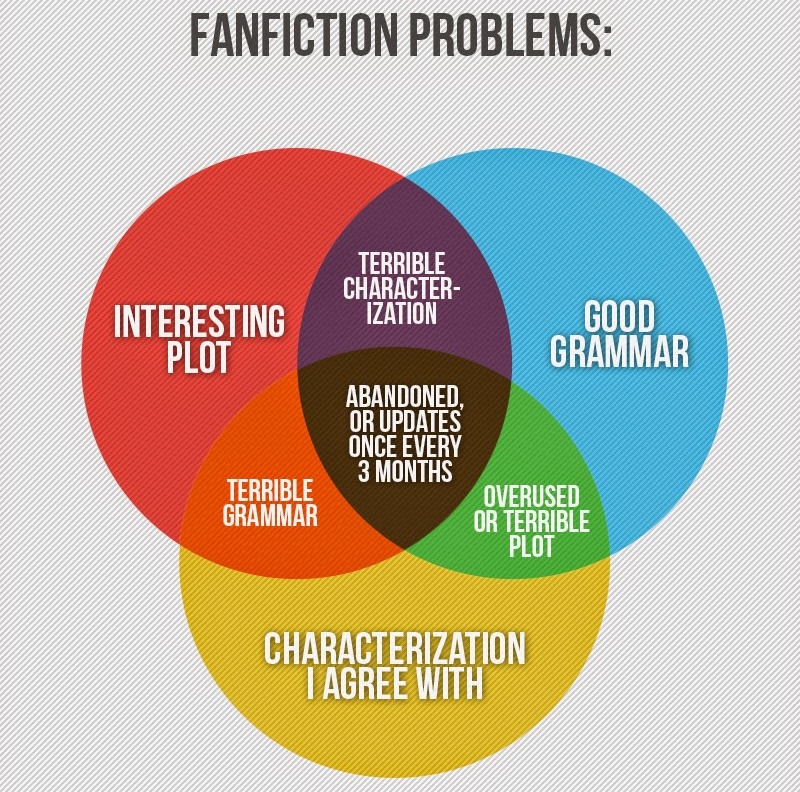
fanficLast week, when talking about how Agents of SHIELD seems to have been written like it was MCU fanfic rather than a true member of the franchise, I mentioned that fanfic isn’t a bad thing and can, in fact, be quite beneficial. It occurs to me that this probably deserves extra attention.

Yes, fan fiction can be beneficial. It’s a great way to encourage creativity, practice writing skills, and generally provide a sandbox for fans to play in.

It’s also a type of fiction that is notoriously riddled with bad writing. We’re not just talking about grammar and spelling. We’re talking about fiction that, quite often, shows little understanding of plot structure, character development, setup and payoff, or even why the source material it draws on is told the way it is.

fanfiction copy Continue reading