I’ve written a few posts that touched on message fiction over the years, especially back during the Hugo Award fight. The latter may have ended, but the general push continues.
Once, in the comments on this blog, someone challenged me to give examples of message fiction, and I surprised him by giving examples of message fiction that I agreed with, including one book that I personally edited. You see, message fiction isn’t good or bad. It’s often referred to derogatively, but its goodness or badness is the same as that of all art: in the eye of the beholder.
That doesn’t mean it’s the goal. In fact, the whole reason why it tends to be looked down on across the spectrum is because it limits your audience.
As I tell my students, you can’t really examine something without first defining it.
message fiction (n): a story or other fictional entertainment that cannot be enjoyed without first agreeing with its message.
In other words, you can have fiction with a message you disagree with and still enjoy it, if the enjoyment doesn’t depend on accepting its premise. For example, I greatly enjoy M*A*S*H, even though it’s (often blatantly) counter to many of my beliefs. I can laugh at Hawkeye chasing skirts without promoting promiscuity, just as I can enjoy the screwball Army humor without being required to protest any war or assume the military is that stupid. Some episodes are heavy-handed, but it’s still pure entertainment.
For me, the truest example of entertainment with strong secondary messaging is still, and probably always will be, the original series of Star Trek.
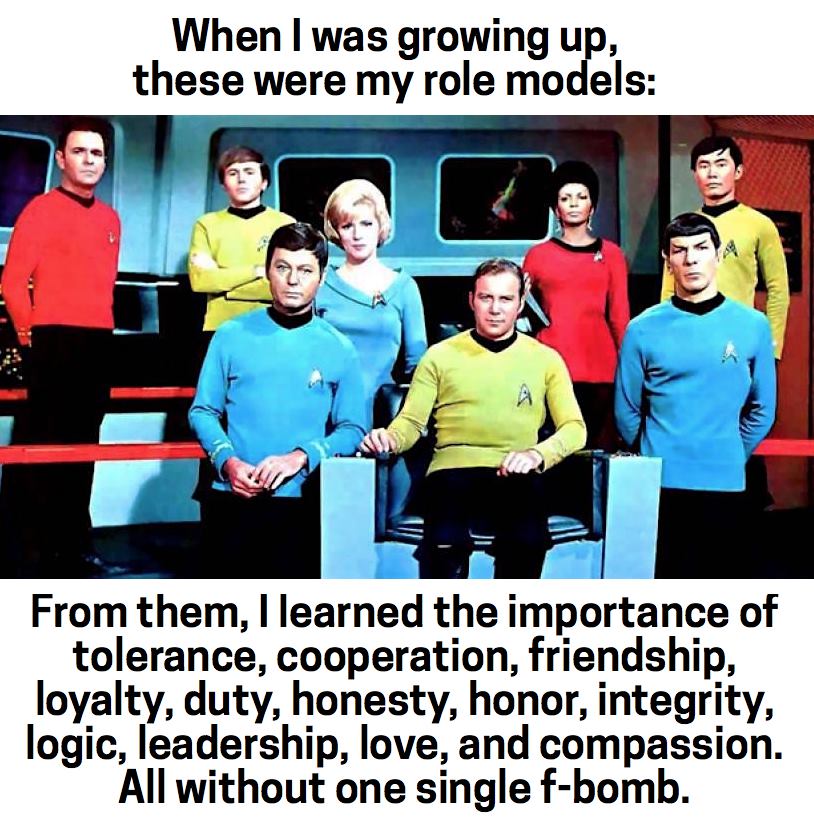
Today, we’re told we should expect things to be heavy-handed. We need it, they say, because society needs it. We have to meet quotas and check off boxes; sex sells, and don’t worry about exposing your kids to racy television because, hey, it’s all racy these days. But we shouldn’t expose them to violence, unless the show fits certain values.
The same thing is true of books, and probably moreso. It’s a truism, especially with science fiction and fantasy, that TV shows and movies will lag about a generation behind novels. This isn’t an accident; the people who grow up reading these novels eventually become the people who make, produce, and consume the same kind of entertainment they grew up with; TV and film requires a much wider audience to break even, and so there’s a delay built in. If you want to see where your children, and much of society, will be in twenty years, take a look at what’s on the shelf.
And increasingly, I find one very disturbing thing there, especially in the YA section. That’s right. Bad quality writing.
What, did you expect I was going to go off on a moralistic crusade?
No, the issue at hand is that today, our books are increasingly forceful in their message fiction, letting entertainment take a backseat to a crusade of whatever values the author finds most important at the time. Really, go ahead and have a message. But fiction with a message is not necessarily message fic. If you really want to spread a message, then go be entertaining first. Let them enjoy themselves, and reach a larger audience with your story.
That’s why Star Trek was so successful at this. It had some very heavy-handed episodes, of course; who can forget the blatant anti-racism message of “Let This Be Your Last Battlefield”? Or the Cold War message of “The Omega Glory”? Vietnam and proxy wars in “A Private Little War”? And yet even the most heavy-handed episodes were fun. You got involved. You cared about the two bi-chromatic aliens figuring out that racism was futile, and were saddened when they couldn’t give up their hatred. You looked at the Comms and Yangs and were glad that endless war hadn’t yet come. You saw the innocence of the Hill People shattered by the Klingons delivering gunpowder technology, and felt that quiet thrill of horror as Kirk faced the dilemma of matching the same technology, guaranteeing war among those they hoped to deal with peacefully, or watch entire cultures be wiped out in the name of noninterference.
We love Star Trek for its thrilling action, but we remember it for its skill at holding up a mirror and making us think, even for a moment, that it was a window.
By the time I was old enough to appreciate how bold it was for its time, Star Trek taught me it was completely normal for an American, a Scotsman, a Japanese, a Kenyan, and a Russian (to say nothing of numerous aliens) to work together with no cultural frictions, and all appropriate for kids to watch. We all know the story of Nichelle Nichols wanting to quit because she didn’t do anything and being talked out of it by no less than Martin Luther King, Jr.; but I distinctly remember being a little kid and thinking Uhura was the busiest person on the ship because she was always doing something. Damage control, coordination, communications . . . Scotty might operate the ship, and Kirk might command it, but Uhura ran the place. Even as an adult, being able to see why Nichols wasn’t happy with her role, I still can’t shake my younger self’s feeling that whenever Uhura left the ship, no one knew what to do because she wasn’t around to give orders.
And that was the impression of a little boy in the 80s and a teen in the 90s, long after the Civil Rights era. Dr. King was right: Uhura was an icon for the entire nation. How many boys and girls in a previous generation grew up with that same impression? How many used her as a role model?
Not once did she get singled out as black among Starfleet, and that was something that continued for most of the later installments. Racism very rarely came up. We saw a future where we were past all that. We saw a black who was an equal. We saw a Russian who wasn’t a threat. We saw a Japanese who fit in without being a token.
It’s a powerful message, made all the more tremendous by how subtle it is. We didn’t have it thrown in our faces. Today, you almost always have to pause the show to acknowledge this one is different, look and see. And then occasionally you have that same thing happen, such as in the first season of The Flash when Captain David Singh is revealed as gay not by pausing the show, but by a minor moment when he refers to his fiance as “he.”
That is the lesson of Star Trek. If you want to make something seem normal, then treat it as normal. Shock value has its place, but you don’t need it all the time. You can show a strong woman or a confident man without tossing them into a sexual situation; you can show someone is upset without strong language; and you can deliver a message without taking a break from the action.
The problem with heavy language and sexual suggestiveness isn’t prudishness. It’s that it becomes less exposed to children. Keep it a three-generation show (as they say in the UK — something a grandparent, parent, and child can all watch together) and you can reach everyone. The strength of Star Trek was in reaching everyone with that kind of story, without feeling like you were getting a Sunday sermon or a political speech. Pure entertainment doesn’t mean it has to go in one ear and out the other.

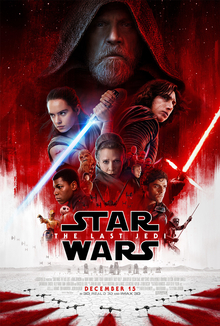 In my review of Star Wars: The Last Jedi, I decided to focus on my primary interest as a writer: characters. Instead of being a movie review per se, it’s more of an exploration of the arcs and plotlines surrounding the various characters or groups of characters in the film, with looks back at The Force Awakens and the original trilogy. For me, character creation and development are the best part of story writing, and excellence in these departments is critical to any good story. Let’s see how The Last Jedi scored.
  Novel Ninja
Maps with Blasters & Blades
As I said a few posts ago, I finally got the push I needed to start updating this site when I agreed to be on the Blasters & Blades show and podcast. The episode was a fireside chat on maps, but as you might expect with seven nerds chatting about things it tangetted a few times. I’m not even the least bit sorry, because it was fun.
Here’s the link to the audio on Spotify, or you can watch the video below for the extra map visuals (and have a better idea of who’s talking).
Maps a a great bonus to have in fiction, but they should always be a bonus and not strictly necessary to understand the story. You don’t want to depend on readers flipping to the map whenever they get confused; actually, you don’t want them to get confused, period. Instead, you want them to flip to the map when they’re so interested in the story that they want the extra visual. When The Fellowship of the Ring mentions Mordor, the reader should ideally know approximately where it is already before seeing the map, and the map itself should be clarification rather than a primary source.
A simple map is good, like the extremely bare-bones map used for much of the Honor Harrington series by David Weber; it gives the minimum information you need and moves on from there without distracting you. Complex maps like in Tolkien’s Middle Earth setting aren’t complex because of geography, though, as most of the complexity is due to the art itself. That art isn’t there for its own sake, but rather to give the feeling of an expansive world with interesting terrain, full of amazing stories that happen just out of sight of the characters you’re actually following. Both styles help immersion in different ways: one by not getting in the way of your imagination, the other by encouraging your imagination to run a little wild for a while before drawing you back down to (Middle) Earth.
Not all maps are of geography, though, whether geographic or stellar in scope. In a story where relationships are important, like Pride and Prejudice, a character map is very helpful. A ‘murder wall’ or ‘conspiracy map’ can help visualize the connections between various clues and suspects in a mystery or thriller. A timeline is another kind of map, much more linear but full of detail that puts things in context, and can be especially important in settings that reference multiple different calendars, or as a histomap that can show the relative scope of something over time. You might have a diagram of a ship like the Enterprise from Star Trek, or a chart of magical abilities like in several different Brandon Sanderson series. (I’d love to post examples of each of these, but it would make this post rather challenging to scroll through.)
Presenting them as a visual medium, rather than a grand Wall o’ Text, helps a reader absorb the information faster and stay immersed in the story. That’s not to say that blocks of texts aren’t good bonus materials, but they’re better as something your readers can access on a wiki, as part of your Patreon, in your newsletter, or (if you’re really successful) as part of a supplemental behind-the-scenes/about-the-world book that your dedicated fans will snap up, such as The Dragonlover’s Guide to Pern, or the hard-to-find (but I have a copy!) Atlas of the Forgotten Realms.
(Yes, the latter is a D&D campaign setting, so arguably its nature is supplemental materials to begin with, but that particular volume was intended as a supplement to the novels rather than the game. You know, back when those novels were good. Hmm, I should do a blog post on the early Realms materials.)
If your map, whatever it is, has a significant amount of information on it that isn’t relevant to either the story or the map, then you’ve probably included too much. By ‘relevant to the map,’ I mean that there are plenty of map elements that aren’t necessary to the plot but put the map itself in better context by pointing out certain landmarks or making the world feel larger. Your story might mention a particular country but not mention its capital; but if you mention the capitals of two other countries and mark them on your map, you should probably mark the capital of the third, too. However, if you’re detailing a map and the action only takes place in one small corner, your map may be too large; one exception is that if the next few books will go there, putting the larger map in for context might be important.
Conversely, as the series expands, it’s necessary to update the map some more to include places mentioned so far. While I praised the original Honor Harrington map for its simplicity, the way it remained static for so long despite so many star systems being introduced was a detriment until it was finally updated.
There are also in-character, in-world maps that can be very useful in other ways, and we discussed those in the episode above. Check it out, but you might want to grab a drink and a snack first because it’s over an hour long.
Share this: