Category: Resources


Okay, geek fans. We all know that Firefly was one of the most awesome things in the history of geekdom.

And if for some reason you disagree, then *fingers in ears* LALALALALALA I CAN'T HEAR YOUUUUUU . . .

And if for some reason you disagree, then *fingers in ears* LALALALALALA I CAN’T HEAR YOUUUUUU . . .

I could go into lots of reasons why it was a great show, but that’s not the point here. The point of this post is that there is a sort of shared community among Firefly fans that can’t ever be duplicated (well, except by Star Trek fans in the 70s . . . or Doctor Who fans in the 90s . . . never mind, you know what I mean). It’s a shared rapport over not just what it was, but what it could have been. There’s nothing more powerful than the imagination for that sort of thing.

And when you have a rapport like that, you tend to band together. And when you band together, you tend to find other fun things to share. And sometimes the people who help create those fun things show up too. And when that happens, you call it a convention.

And now Alan Tudyk and Nathan Fillion, with Gina Torres, Felicia Day, Seth Green, and James Gunn, are going to make a series about that experience.  Continue reading
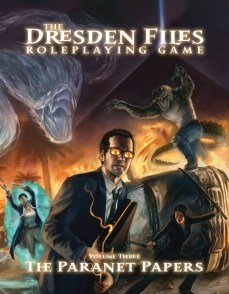
Paranet PapersLongtime readers may remember that I had some input on the Fate Core RPG system. (Yes, that is my name on the cover of Worlds on Fire. They didn’t tell me that was happening.) Evil Hat Productions and I haven’t had business together since, but Fate remains my favorite RPG system, and I actually have a review for one of their latest offerings in the pipeline.

Today, however, I just want to share the news that the long-awaited supplement for The Dresden Files RPG is finally scheduled for publication. The Paranet Papers will be released on June 1st.

“Big deal,” you might say. You’re not interested in anything other than the next Dresden Files novel. Why would you want an RPG supplement? I’m glad you asked, Mr. Strawman! Continue reading

You know you’re a sword geek when you notice the sword before anything else on the cover.

Okay, let’s face it. Like most men, I’m a sucker for a pretty face. Like most geeks, I’m a sucker for a pretty face with a smart brain. But give that smart, pretty woman a sword, and . . . sorry, where was I?

When my friend and future co-author Elizabeth Hajek was offered the chance to host a giveaway for Michelle Moran’s upcoming book Rebel Queen, I thought “good for her.” When I realized it was about Rani Lakshmibai, I thought “I should really buy this book because history and battles and sword-wielding queens oh my.”

Now, I should say that I know about as much about Indian history as I do about American football. That is, I can kind of recognize the names involved and where they’re supposed to go and vaguely how things fit together (though I still can’t find the goalie), but just like I’ll confuse an NFL team with ones that play baseball (that’s the one that plays indoor and bounces the ball a lot, right?), I’ll get north and south India mixed up, which, take it from me, is worse than getting northern India mixed up with Pakistan.

However, as I read the back cover text for Rebel Queen, I realized that I had heard of Rani Lakshmibai.

Continue reading

If you’re viewing this anytime after this week, I’m sorry. But hey, you get a review, right?
Audible.com is running a sale on the first books of series. There are several good choices, all for $4.95 each, but I didn’t go through the whole thing yet. I got distracted by William Shakespeare’s Star Wars: Verily, a New HopeContinue reading

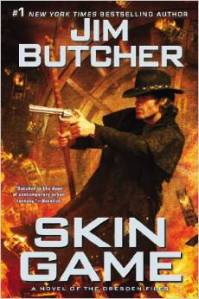
download (1)I keep getting side-tracked when it comes to making blog posts. The new job, plus finishing contracts on the old one, is taking up a lot of time. However, I had to write up a review of Skin Game by Jim Butcher, the latest Dresden Files novel.

If you don’t know what The Dresden Files is (or if you only know it from the failed TV show that bares little in common with the books), here it is in a nutshell. Harry Dresden is a wizard. A professional wizard. The only professional wizard in Chicago, to be exact. He’s even in the phone book. He’s a card-carrying member of the White Council, the semi-secret (mainly because normal people don’t believe they exist rather than because they try to hide) semi-government of mortal magic users. They also, to some degree, protect mortals from supernatural threats: vampires, demons, warlocks, werewolves, faeries, and other things that go bump in the night. And, in Harry’s case, they try to pay the rent while doing it.  Continue reading

Fooling the Audience

Normally I ignore April Fools’ Day, but it occurred to me that it would be thematically appropriate to talk about a valuable writing skill: hiding things from your audience.

“Wait, what? Hiding things? That doesn’t sound like a good idea! The whole point of writing is to tell them things!”

Exactly! But you don’t just tell them the end first, do you? You build up to it, with clues that set up the twists, but then hide those clues so that it’s still a surprise to all but the most eagle-eyed.

I feel I should issue a warning, though. Learning these concepts can lead some people to feel that all stories are ruined forever. If you’re just here for the reviews, don’t read any further. Personally, I find it enjoyable to spot the tricks, especially with a skilled author; it doesn’t ruin it any more than knowing how to spot individual brush strokes will ruin a masterful painting. Still, I’ve seen people become disappointed, and so I give you fair notice.  Continue reading

Don’t Dump

One of the most common mistakes, even with professional storytellers, is to deliver a lot of exposition in a small space, or otherwise give “idiot lectures” where you have one character being a bit more dumb than usual simply so that a second character will have to explain something to him (and therefore to the audience). This is often called infodumping, and it’s often hard to avoid — but the best authors watch out for it and work around it.

Continue reading

You may or may not have heard the latest faux controversy about J. K. Rowling. No, it has nothing to do with her characters. Instead, it’s a Huffington Post writer named Lynn Shepherd complaining that Rowling is such a good author that she’s crowding out everyone else. She tells Rowling that she should just stop writing and give other people a chance. If you don’t want to click on her article, here’s the summary: Rowling has too much of a market share, which means every book she publishes is a book overlooked from another author who hasn’t become famous yet.

There has been a lot of pushback so far. I won’t post more than one link, mainly because the BBC’s article has more than enough links from successful authors who say this is ridiculous. I wasn’t even going to do more than link to that article, because every single point has been refuted multiple times by the authors linked there, and that’s just a small sample so far. What could I add? Continue reading

Readers of the blog know I like Lego. It’s a great toy, arguably the best single toy investment you can make for a child. Unlike a video game, its operating system doesn’t go obsolete in three years; every Lego brick you buy today is compatible with the same company’s products going back decades — and they’re not going to change that in the future. It rewards creativity, teaches spacial and structural awareness, and can be combined in so many different ways that you can never say you’ve beat the game.

And then, as an adult, you can stick with it and turn it into a genuine art form. Years of experience, an adult’s funding and patience, and that little kid inside of you that still shouts “THIS IS SO COOL!” — all joining together to show kids that art can be fun, and their fun can be true art.

Well, there’s a movie out this weekend that’s based on the toy. I got to see the press screening last weekend with Wamalug (the Washington Metropolitan Area LEGO Users Group), so I’m here to give you my review. Continue reading

History and Stories

I can go on and on about stories until my voice goes raw or my hands cramp up, depending on how I’m talking to you. Because of that, it often surprises many people that I don’t have a single degree in literature. For now, my highest degree is actually in history.

Why is that? Well, I maintain that a history degree — assuming that you’ve had a wide-ranging focus and look at many different cultures — is one of the best fields to truly teach you how to write. That’s because most lit degrees teach you about other books, but they don’t tend to teach you about people. Make no mistake, both history and stories are fundamentally about people. Continue reading