Latest Entries »

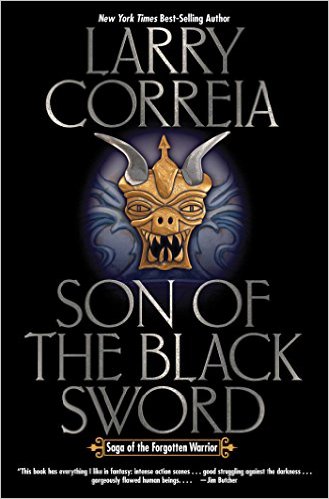
Son of the Black Sword 1A few weeks ago, I finished Son of the Black Sword, the latest book from Larry Correia. I’ve been delaying on writing blog posts, so this review isn’t the only one on my to-do list; but the thing is, if you like fantasy that’s a little bit different, you need to read this book. You’ll thank both me and Larry later.

Son of the Black Sword is the first in a new series for Correia. It’s also marketed as the first in a new genre; that’s not really true, since he’s been writing Iron Kingdoms tie-ins, but when it comes to his original fiction he’s known as an urban fantasy writer. He’s most famous for his bestselling Monster Hunter series, a contemporary story about a group of contractors whose job it is to hunt and kill the monsters humanity would rather pretend don’t exist. Second to that (and my personal favorite) is his Grimnoir Chronicles, an epic-scale alternate history/fantasy set in an alternate Great Depression where magic exists and the West is in a cold war with Imperial Japan. (Also, there are airships and Tesla superweapons.)

Compared against that, Son of the Black Sword is definitely something different — and not just because there isn’t a single gun to be found. It’s an epic fantasy, of the sort that might normally be described as “traditional fantasy” until you read through the first chapter. Son of the Black Sword is set in a world that heavily draws on South and East Asian concepts, in terms of society, politics, philosophy, and even the fantasy itself. But that’s all mere backdrop, however well-painted, supporting a story with three major twists, five minor twists, and a story where you’re not sure quite what’s going on but you’re hungry, starving for more.

This is epic fantasy at its finest. My favorite epic fantasy remains David Eddings’ The Belgariad and The Malloreon, despite such personages as Brandon Sanderson redefining and expanding the genre. Larry Correia is now approaching a rival for Sanderson, and after this start I would not be surprised if he starts rivaling Eddings for me on pure enjoyment.

Spoiler Warning

As you might expect, minor spoilers ahead. Only minor ones, though, so if you want to read more you should be safe.  View full article »
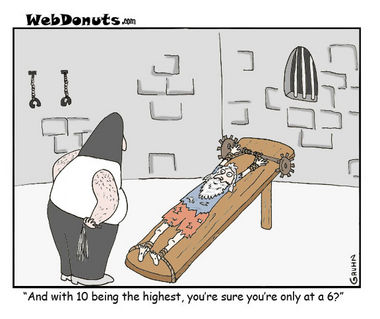
high-pain-toleranceThere’s a common misconception about people with high pain tolerances. They tend to be big, beefy, and burly, usually men, and if female they’re all badasses. They shrug off bullets and sword-thrusts like they’re minor distractions; they grunt from the pain and rarely, if ever, scream.

Now, I frequently impress people around me with my high pain tolerance. Most of that is in awe; some few, such as my doctors and a close friend who helps me exercise, approach it with worry, because pain is an important thing. I have such a high pain tolerance that I often automatically ignore signals that I should really stop what I’m doing and rest. I threw out my back (a little over a year ago) and my knee (a couple months ago) precisely because I could just work through the pain . . . until I suddenly couldn’t.

How do I do that? Well, it’s not because I’m tougher than other people. I’m not beefy or burly, and I’m only big if I’m standing up and haven’t turned sideways. It’s never about your mass; it’s all about what you’re used to. Establishing that difference is the key to writing action heroes and other characters that deal with pain through the course of your story.  View full article »

Customs of the WorldWhenever I talk characters and worldbuilding, at conventions or in classrooms, I always recommend several books. One of them actually isn’t a book at all, and it’s the only one that I mention in both contexts.
It’s a lecture series from The Teaching Company, titled Customs of the World: Using Cultural Intelligence to Adapt, Wherever You Are. This is intended to be a course on understanding world cultures, but it’s a vital resource for creating cultures in both fantasy and science fiction. It’s also a great secondary resource for creating different personalities between characters.

As of this post, it is currently on sale at The Teaching Company’s website, starting at $35 for an audio download. I cannot recommend it too highly. You should all go get it now. If, however, you’re reading this after the sale has ended, I’ll explain why it’s worth getting. View full article »

It’s no secret that I have a love-hate relationship with Agents of SHIELD, a show I had high hopes for which turned into something I abandoned, continued with again because of a friend’s insistence, and then would have abandoned again if it weren’t for how it gives me stuff to blog about. (When I remember to update the blog, that is.)

I rarely try to suck up every single bit of information about shows that I can. Part of it is because I don’t have a regular TV-watching schedule, and so sometimes I wind up taking in several episodes at a time and would prefer to avoid spoilers. Sometimes I just don’t care. Sometimes it’s just that I’d rather take it in as the story itself, as it was meant to be viewed. It’s somewhat of a treat for me to do that, actually; well, if it’s a good story, that is. I honestly should write a blog post on an editor’s perspective of stories both published and in draft form, but suffice for now to say that it’s hard to not feel like I’m working.

With Agents of SHIELD, even when it stopped sucking, I was still working. Even when it was good enough that I could enjoy it, it was still short of something I could sit back and enjoy on its own, without being an editor the whole way through. That’s probably why I wrote so many articles about Agents, but not about Flash or Arrow.

Last night, the season premiere of Agents aired, and I enjoyed myself. I had to remember to pause to take notes every so often. Last season, I cautiously opined that this was starting to live up to the hype when the show was first announced; now, it is the show that they announced. And apparently all they had to do was say “Hey, X-Men is a cool story.”

Oops, I need one of those spoiler banners before I say stuff like that, right? It’s been all summer. I’m rusty.

Spoiler Warning

View full article »

If you haven’t seen it already, Netflix released a teaser for Jessica Jones over the weekend. It is a thing of beauty.

As my friend and fellow blogger (over at The Catholic Geeks) Andy Hauge observed, it sums up the tone of the show perfectly.  View full article »

Last night, I was speaking with an unpublished author who confided a very common fear: that self-publishing isn’t really publishing, because as a newcomer she wants that stamp of approval that comes with a publisher’s imprint.

Now, this author isn’t one of mine, and in fact isn’t even in my category, much less the SF&F genre. She’s a nonfiction author who has written a self-help/motivational book that, frankly, sounds interesting. (And I rarely say that about motivational books, since I find them to be . . . well, less than motivational. Literally the last good one I read was about eight years ago, and it was very atypical.) But this author’s fear is not only understandable, it’s very common.

It’s also part of a misconception. See, as a reader, you naturally look up to authors and their publishers (or, even if you don’t because they suck, you feel that they suck all the more because you’re not able to treat them with reverence). These are professionals. Their opinion has weight, and you would love to be their equal, or at least the rookie on the team. Their recognition is what proves you’ve succeeded.

Not true. Very, oh so very, not trueView full article »

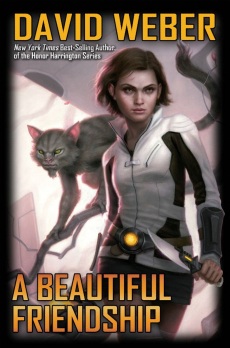
Star Kingdom - A Beautiful FriendshipA few years ago, I read A Beautiful Friendship by David Weber. It’s really two novellas in one; the first was originally one of three in Worlds of Honor, the first Honorverse anthology; that novella (also titled “A Beautiful Friendship”) detailed the first meeting of a human and a treecat, the latter being the native sentient species of the planet Sphinx, fifteen hundred years in the future. The second half of the novel version deals with the immediate fallout of the story.

While the original short story was aimed at regular readers of Weber’s Honor Harrington series, the novel version began a new spin-off series (taking place four centuries before the main series) that was being marketed as YA. This summer, I read the next two books in the series, co-authored by Jane Lindskold: Fire Season and Treecat Wars.

The series almost manages to be stand-alone with regards to the main Honorverse books; I say almost, because I feel there’s something a bit lacking to it. Unfortunately, to explain why, I have to describe some of the parent series. View full article »

This has been a very busy summer. Between work and family commitments, I’ve been running around so much that when I get back home I just really haven’t had the energy to blog. Heck, my work has been cutting into my vital goof-off time, and we all know how important that is. I didn’t have time to review a single item on the Hugo ballot this year like I’d expected, and I quite literally finalized my ballot only on the last day. I had to skip the fan and related work categories, too; I just didn’t have the time to finish those.

This last weekend was particularly hectic and stressful, to the point that reading about Hugo kerfluffles online was relaxing by comparison. I didn’t even think I should blog about it, but decided I could probably squeeze off a quick post.

The short version: I can’t say I’m surprised. In fact, I can’t even say I’m disappointed.  View full article »

Emails

Just a quick announcement: I know that some of you are waiting on emails. Some of you, in fact, have been very patient. I’m getting to you. 🙂 This has been the busiest summer I’ve had in over ten years!

ant-man-thor-poster-1In my review of Ant-Man, I mentioned how the movie couldn’t make up its mind as to whether it was a caper film or a superhero origin story. I laid out the reasons why those two types of stories are, if not incompatible, then at least problematic to mix together. I also mentioned I might do a post on how I might have adjusted the movie if, for some strange reason, they came asking for my advice.

So how would I have done the movie differently?

This is actually a more dangerous question than it might appear. I’m a prose editor. I’m a pretty good one. I’m also pretty good at analysis, developmental/structural rewriting, and closing plot holes. None of that means that I’m good at scriptwriting. Visual media is a very different ballgame. I know just enough about the differences to talk about them, and not enough to actually put them into practice. I’m a professional editor, but I’m an armchair amateur when it comes to script-doctoring. I know my limits and I’m not going to pretend that expertise in one form of fiction extends to another.

So, disclaimers aside, here’s my armchair amateur opinion about what I’d have done if I’d been asked to give a developmental edit (also called structural editing) on the film.

Spoiler Warning View full article »