Latest Entries »

It’s been a few weeks since my last post on the Hugo Awards. I haven’t had much to say, because my only concern in this matter is on the subject of writing. I’m not interested in responding to every little thing that pops up, such as news articles that repeat lies, Big Five editors who make up new lies, fans who leave one-star, one-word Amazon reviews on Hugo-nominated works . . . I’ll leave that up to others. Sure, it gets me great traffic, but I’m interested in writing, reviews, and fun stuff to share. The Hugo Awards are too serious, yet too inconsequential in the long run, to just keep harping on the same points over and over and over and . . . you get the idea.

Joker Hugo Awards

(Actually, if you want over-the-top Hugo humor, check out my friend Declan’s parody of the Sad Puppies people encountering SWATing and Worldcon. I make my own appearance in the latest installment. Apparently my house is made of Lego. I don’t find this repugnant.)

bullshit-asymmety-principleAnyway, long story short, I’m writing another Hugo post. This is because someone decided to leave a long comment on a previous post that requires a few more counterpoints than is easy to do in an answering comment. As such, I’m doing a full-on fisk, and invoking Brandolini’s Bullshit Asymmetry Principle.

The commenter’s name is pocketnaomi. As such, I’m assuming this person is a woman named Naomi, and will be addressing her that way. View full article »

Avengers: Age of Awesome

avengers-age-of-ultron-alternateWas there any doubt that Avengers: Age of Ultron would be a fun movie? Was there any doubt that the existing fanbase would love it? Was there any doubt that the movie would be a hit success? No, indeed. The only doubt was how good it would be on a scale of 6 to 11.

Rest your doubts. It’s at least a 10.9.

Note: This is not a spoiler-free review. However, unless you’ve been avoiding the trailers, you’re safe until you come to the big spoiler graphic. After that, you’ve been warned.

Superhero stories have traditionally been plot-driven. Things happen in a particular way to have a particular end, and that’s the only important thing. We all know how annoying that can be. Sometimes it’s good, sometimes it’s horrible. However, the MCU has mostly stayed true to character-driven stories. There have certainly been ones where plot mattered more (Thor: The Dark World and Agents of SHIELD season one come to mind), and others where character and plot intertwined to the point where you don’t care that a story had to go this way to set up something later, because the characters still had their day (Guardians of the Galaxy and Captain America: The Winter Soldier).

Of course, character-driven stories aren’t automatically better, because character without consistent plot is unsatisfying. Think of Iron Man 3, which was a fantastic movie from the perspective of Tony Stark’s character development, and rather sucky for the rest.

The first Avengers movie remained a shining example of a character-driven story, as Ross explained earlier this week. My biggest worry about Age of Ultron was that it might not live up to that standard. In point of fact, I think Age of Ultron actually exceeds its predecessor in that regard. While the movie actually lacks a little of the stand-up-and-cheer of the first, Age of Ultron is now a new go-to example for true character-driven stories.  View full article »

I’m just going to toss them all together today. It’s a superhero gumbo! Or a salad, if you prefer leafy things.

There’s a reason why I’m doing that. Well, two reasons. The one that has nothing to do with laziness is that Arrow, The Flash, and Agents of SHIELD all had a few things in common this week. They all dealt with stakes that have less to do with saving the world, and everything to do with their own humanity.

It’s necessary to up the stakes for a serial story, since if your characters always deal with the same problems then everything is boring. (Or it’s an American soap opera. Or a political election cycle. Or both. Hey, I live just outside DC; you can’t tell me it’s not like a soap based on The Godfather or something.) On the other hand, if you’re constantly upping the external challenges, then your character quickly becomes so powerful that threats start becoming rather ridiculous. That’s even more important if you’re like Superman and you wind up leveling Manhattan in your origin story.

I don't care if you call it "Metropolis." Who thought that an audience would find a climax involving massive buildings collapsing in New York City to be endearing?

I don’t care if you call it “Metropolis.” Who thought that an audience would find a climax involving massive buildings collapsing in New York City to be endearing? I mean, other than Zach Snyder. Anyone? Anyone? Beuller? 

The best way to solve that issue is through exploring human bonds between characters (even if some of them might not be human). As I said yesterday in my post on superhero prose, it’s important to never lose sight of human wants, needs, desires, things that an audience can understand. A massive battle is fun (well, in fiction), but it will never carry the same weight as the betrayal of a loved one. Done right, and the audience can feel a punch in the gut too.

However, from here on out, hic sunt mortiferis. That’s Latin for “If you haven’t seen this week’s superhero shows, you might want to check back later.”

Spoiler Warning View full article »

PowAvengers 2 comes out this weekend. Well, Thursday, in many places . . . which means you might wind up with a lot of geeks missing work on Friday. Me? Ha! I get paid for this stuff!
Well, no, I actually don’t. This blog is a 100% free resource, and I can’t get paid for reviewing Age of Ultron. I can, however, potentially get paid for talking about superheroes in general. (Mind you, I can neither confirm nor deny any involvement in the development of a multi-author shared-world superhero setting. Hush, now. I don’t know how these rumors get started.)

Superheroes have, arguably, been around as long as science fiction or fantasy, at least as separate genres with somewhat dedicated followings. They’ve always seemed a bit separate, however, because they use what I call the fourth medium of print: visual art. (The other three are prose, poetry, and script.) Superheroes have rarely done well outside of comic books, in large part because the visuals have dominated the storytelling so completely that it’s difficult to have the same effect in pure prose. It’s only been recently that film technology has advanced to the point that the big screen can live up to the promise of hand-drawn art.

That, however, is a stylistic difference that more people are accepting these days, and it is entirely because of indie publishing.  View full article »

Avengers Assembled

EDITOR’S NOTE: This guest blog is brought to you by my good friend and former college roomie, Ross Windsor (yes, a distant relation of those other Windsors, but they never invite him for tea). To whet the appetite for the premiere of Avengers: Age of Ultron this weekend, he has a few words to say about the first Avengers movie from the perspective of a movie buff and filmmaker.


I suppose I should start by giving a *SPOILERS* warning, but if you haven’t seen The Avengers yet: STOP. Back away from your computer, go buy the movie, and watch it. Twice.


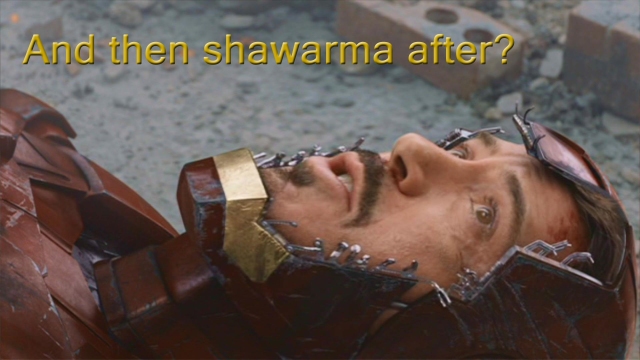
Photo 01 - Shawarma


Marvel Studios faced the relatively unique challenge of bringing together four major heroes from previous film titles, along with lesser (though still important) characters from those films, while making The Avengers stand on its own as a movie. Of the six Avengers, all had made their first appearances in one of the five preceding movies. In order for The Avengers to appeal to moviegoers who had not seen all or even any of the previous films, director Joss Whedon had to introduce every character as if for the first time. And due to the number of major characters, these introductions had to be brief enough to not bog down the story, yet compelling enough to grab the audience’s interest immediately. This sort of quick introduction is a fantastic and necessary technique for short films, but serves well in feature-length films as well, particularly one like The Avengers. View full article »

AwesomeConEmails went out to all the speakers and panelists at AwesomeCon 2015 yesterday, and four out of seven of my suggestions were accepted. I was expecting two at most, so this is fun.

If you’re planning to go to AwesomeCon this year and want to see me talk, three of the events will be on Friday, and one (mostly of interest to gamers) will be on Sunday.  View full article »

Looking Ahead with the MCU

Agents of SHIELD has always had the potential to be the little show that connected the big things. Now, with Marvel getting more little things (that is, TV shows), we have even more opportunities to see the backdrop of the Marvel Cinematic Universe through the eyes of Coulson and his team.

Of course, the problem with that has been that Agents has, well, supremely sucked at doing that.

There are a few other factors, though, even if the writing on the show continues to improve. For one, Agents and Agent Carter (if the later ever gets renewed) are ABC properties. If the Netflix shows pan out the way Daredevil did (I really need to write up my review/analysis of that show!), then that “network,” so to speak, will wind up being stronger, which means ABC might not want to share. On the other hand, Marvel TV contracts reportedly all include the possibility of cinema appearances, while the reverse (cinema to TV) is not true.

What I hope is that Spider-Man will help bridge that gap. In the comics, he’s done plenty of team-ups with Daredevil, as well as the other coming Netflix characters. I’d like to see him show up in both Netflix and ABC shows. Problem is, I don’t know if Sony would think that’s a great idea.

For now, it’s hard to judge where Agents of SHIELD is going after this season. Which brings us inevitably to the Avengers: Age of Ultron tie-in, where reportedly we have multiple characters from the show popping up. Back when I first heard about it, I wasn’t impressed. Now, though . . . heck, even the supremely-boring Skye, of all people, has become interesting. I’ve gone from “How can they do an Agents cameo and make it look anything other than forced?” to “How can they do an Agents cameo and do the show justice?”

My, how things change.

For the rest, though, I need to get into some spoilers for the current season.

Spoiler Warning

View full article »

swearing-at-workWe do it a lot. Of course, we might call it different things. Profanity, swearing, cursing, cussing . . . yeah, we do it a lot.
Of course, not everyone does it to the same degree, or with the same words. Sometimes that can be amusing, at least in certain contexts. A common Australian word for a cigarette, for example, is the same word as an insult for a homosexual in the US. In the UK, a very common swear word (though less severe these days than a few decades ago) simply means to have the quality of blood in the US and Canada. And that’s where everyone speaks the same language.

Swearing serves an important function, and the fact that we all do it to some degree or another means our characters probably should as well; but when should we do it, how much, and why? View full article »

On an author’s recommendation, I signed up for BookBub, a service that sends daily emails about ebook deals from multiple sites based on my preferences. I’ve been using it for a couple of weeks now, and I have to say it’s worth it. Even if the name makes me think of Wolverine.

Actually, the idea of Wolverine sending me emails about books is pretty darn cool.

Actually, the idea of Wolverine sending me emails about books is pretty darn cool.

The service is free to consumers (content providers can pay to have stuff promoted). They do, obviously, collect your email address and taste preferences; but I haven’t noticed any evidence that they’ve sold my information to others (and their privacy terms state that while they share information, they do so anonymously and only in regards to BookBub’s own services as provided by any third parties). That suggests that they might be planning on an expansion later, but for now I can’t find a downside.

BookBub offers the following services: View full article »

I took a creative writing course at my first college. I dropped it later, because the professor didn’t know how to actually teach creative writing. That’s not to say that I knew what I was doing; I’d been writing since I was eleven, and by the time I took this professor’s class I was told by one professional author and another English professor that I was publishable, but I (today) wouldn’t consider myself (then) to know what I was talking about any more than that professor. I learned far more from the assigned texts than I did from her.

The problem with many creative writing courses is that they spend a lot of time teaching you what not to do rather than what you should do. That’s a lot easier, I suppose; as I frequently say, writing is an art, not a science. There are a few ways to fail, and an near-infinite number of ways to succeed. It’s easier to talk about what not to do. The problem is that these courses go on and on with their rules rather than treating it as an art form. When I teach writing, I actually approach it the same way one might teach drawing or painting: here’s some stuff to try, and here’s how to refine it. The rules of fiction aren’t the laws of physics.

blogger-image-1782337503

One such rule, which this professor was quite strict on, is one that many of you will no doubt have heard. Don’t use adverbs. The professor in question was even more specific: “Don’t use -ly words.” Whether she didn’t care about adverbs that didn’t end in -ly or she just thought we didn’t know what an adverb was, I don’t know; it could honestly have gone either way. (You can tell I didn’t enjoy that class.)  View full article »