Latest Entries »

Alpha, Beta, Editor?

Over the last few months, I’ve been surprised to encounter several people (including established authors) who don’t know the distinction between alpha and beta readers. As a consequence, this got put into my Stack of Stuff (aka the list of “Gee, I should write a blog post about that” topics).

The most common definition I’ve encountered among authors, fellow editors, and laymen was that an alpha reader was the first reader, and everyone else who read it before publication was a beta reader. That’s wrong; not completely off, mind you, but wrong. I was a little surprised, but it makes some sense that people would think that just from the names. There are other distinctions, though, even among people who know the origin of the two terms.

That same origin might be the cause of some of the confusion, though. The two terms come from software testing, where alpha testing is done during development by professionals while beta testing is conducted with members of the general public. The fact that “alpha reader” and “beta reader” come from something so tech-based might make the terms seem a bit arcane to people not already steeped in this stuff, and the vast majority of people I’ve talked to who didn’t know the definitions weren’t people who considered themselves geeks.

Of course, I learned about the definition so long ago that I can’t even remember how it first came up, only that I knew it was a while before I connected it with “beta test software” and the like. So who knows? Tracking the differences in my friends and coworkers has been interesting, but hardly conclusive. And probably boring to most people, so let’s skip ahead to the meat of the matter.

When you’re looking for an alpha reader, you’re looking for someone who knows about writing. You might ask experts in fields you’re writing about (law, history, medicine, engineering, astronomy, whatever) to read parts of your book before it’s finished, but they aren’t alpha readers. An alpha reader is examining your story, identifying parts that work, making suggestions about parts that don’t, and generally giving you semi-professional feedback. Your alpha readers are generally reading along as you write and rewrite the first few drafts. They generally have to know something about writing themselves, so most alpha readers are either writers and editors or they’re close friends and family who know you and your writing very well. (The most common non-professional alpha reader seems to be the author’s spouse. That probably won’t surprise anyone.)

Like with software companies entering beta-testing phases, you want a beta reader when you feel you’re almost ready for publication. It might not be quite done, but you feel most of what is remaining is a matter of polish and line-editing. You don’t necessarily have everything phrased the way you want it, but you’re done moving chapters around and changing the ending. Your writing might need some work, but your story is finished. That’s when you get your test audience: trusted friends, significant fans, people who would be normally reading the sort of thing you’re writing. They’re a sampling of your audience, and as such they don’t need to have any professional writing knowledge. You just want to make certain that your target audience likes your book.

Oh, that doesn’t mean you can’t have beta readers looking for mistakes, whether they be typos or factual errors. That’s actually encouraged most of the time; in fact, publishers and authors alike, when they send out something to be read, will usually only mention proofreading when they don’t want you to do it.

So where does an editor fall in all of this? That was another source of confusion among people I talked to. The simple answer is that an editor — meaning your editor — is in a different category. If you’re submitting a finished manuscript to a publisher, you’ve probably gone through both alpha and beta reading first. You might have even hired a freelancing editor at some point. You might be discussing ideas with your editor before you even start writing. An editor can come in at any point in the process. Our job as editors is to help you build, create, shape, and entertain. Depending on the project and where you are in it, your editor might be dealing with abstract plot sketching or something as specific as figuring out what word-choice habits a bit character might have in chapter twelve.

But as vital as my job is, I’m only one person — and as I repeat so often I sound like a broken record even to myself, even an editor needs an editor. Cultivate your alpha and beta readers. They’ll catch things that you and your editor miss. They’ll have ideas that you and your editor wouldn’t think of. Usually they won’t be what you want; only you can tell your story, after all, but even knowing what will not happen helps when you’re not certain what will happen. Bouncing ideas off your readers as well as explaining to them why their suggestions won’t work will improve your art.

Momentarily Found

While looking for something to watch, I found a short-lived (one season) mystery show called The Finder. It’s a quirky sort of show — the sort of quirky I associate with Doctor Who (particularly the Tom Baker years) — about a former Army officer who suffered a brain injury in the Middle East that has given him extreme paranoia, a lack of social inhibition, and an uncanny ability to find anything from just a few clues.

The show was (loosely) based on The Locator series by Richard Greener, but was presented as a spinoff of the TV show Bones (also based on a book series). I didn’t realize that until I saw the second episode and one of the Bones characters shows up (Dr. Sweets, evaluating whether or not the title character, Walter “the Finder” Sherman is insane and therefore able to still consult for the FBI and other federal agencies).

Now, I make no secret of the fact that I’m not much of a Bones fan. The title character for that show, Dr. Temperance “Bones” Brennan,” is presented as a scientist devoted to rationality and empirical study and cites logic more often than a Vulcan, but the writers obviously don’t know any more about logic than Gene Roddenberry. I happen to be very good at that, and I spot logical errors faster than a crooked lawyer finds loopholes. When a character is presented as logical and completely fails at it, I get frustrated. Since the whole show revolves around Bones and her ability to look at things rationally, the whole show is tainted for me. I just can’t stand it. Cheese grater to the skin.

The Finder is pretty much the exact opposite. Where Bones takes itself seriously, The Finder is the relaxed guy on vacation constantly insulting himself over mojitos. Where Dr. Brennan approaches things rigidly, Walter thinks nothing of doing things that other people would find crazy. Sometimes it’s deliberate; sometimes it’s because he really is crazy. He’s exactly as presented, and he acts completely in character. (I’d say I wish the creators of Bones had paid attention, but really I just want them to take a logic class.)

As a mystery show, it’s presented a bit differently. Each mystery revolves around finding something — an object, a person, or even an idea. There’s usually a crime involved, but that gets solved only incidentally as part of the finding. Because of that, while it uses the traditional mystery structure, the presentation makes it very fresh.

As much as I like the title character, though, he isn’t my favorite. He’s actually my third-favorite character. The best is Leo, his partner, legal advisor, and the owner of the bar The Ends of the Earth where clients can find the Finder. Leo is a lawyer, mostly muscle, and constantly quoting philosophy and legal codes. The actor (who unfortunately died of complications from a heart attack) has a perfect deadpan delivery that exactly counterbalances Walter’s Time Lord-style zaniness without making him seem stodgy or humorless.

The second-best is Willa, a Gypsy delinquent working at The Ends of the Earth to serve out the terms of her probation. Her Romani “family” serves as a sub-plot for the series, culminating in one-half of a cliffhanger that you can see coming a mile away and still has an emotional impact. She’s simultaneously more and less mature than Walter, impatient as only a teenager can be, and grows to be an important member of the loose “team.” I expected her to be a pretty flat character at first, but the show gives her a surprising depth that really makes you sympathize with her and realize how torn she is about her life.

The fourth main character is Isabel Zambada, a Deputy U.S. Marshal who serves as the law enforcement contact and Walter’s love interest. She wound up being the weakest character; not boring by far, but still not as good as the other three. Plus I kept noticing mistakes she’d make with her gun (including one error that I’ll place on the shoulders of the costume department but have no clue how they were so blind — namely, they put her small-of-the-back holster facing the wrong direction in one episode, as if she were left-handed).

The show is only thirteen episodes long, and ends on a two-tiered cliffhanger. I won’t spoil it, but all four characters’ lives are shaken, possibly permanently. The problem is that you’ll never find out what happens next.

If you’re looking for a different kind of mystery show, and particularly if you’re a Whovian who wants that zaniness on the off-season, head over to Amazon or Netflix and give it a try. Just remember, I warned you about that last episode. If you wind up watching the first twelve, you’ll want to watch the finale, and you’ll find the lack of a “next episode” button to be cruel and unusual punishment. Apparently, not even the Finder can locate the next season.

The show has mixed reviews, though. I’m obviously an instant fan, but let me know what you think in the comments below, or over on Facebook.

Tomorrow night, I’ll be on a Google Hangout with the other editors and writers who worked on Fate Core. Unfortunately, I don’t have a link to give you. I’ll update this post when I know.  The hangout is supposed to take place at 9pm Eastern.

Edit: And just after posting, I get the link. Come on by!

Quick Hit: Man of Steel

I went and saw Man of Steel today. Better than expected. Best treatment of Superman’s origin I’ve seen, which is a pretty low bar to cross to begin with. Best portrayal of Lois Lane I’ve encountered live, animated, or in print, which is a higher bar. (Perfect blend of helpless human and capable female.)

I’m not a Superman fan. By far. I just don’t like him. I don’t like his character, I don’t like his powers, I almost never like his stories. (In fact, the only good ones I’ve seen have Batman in them.)

It is, however, not a good Superman film. That climax . . . no. Sorry, no.

One more thing!

Always listen to Uncle!

Who says you can’t learn anything from a Saturday morning cartoon? Uncle’s timeless advice always pops up when I get excited about research. (Mind you, it’s usually accompanied by the mental image of an old man whacking me on the side of my head with two outstretched fingers.)

And yes, research can be exciting. If you’re not eager to learn new things and insert them into your craft, you’re probably in the wrong business. Not all research is fun, of course — but from the number of authors and editors I see who share things they find on social sites, it’s fairly obvious that I’m not the only one who likes finding new things.

And I not only enjoy it, but I’m actually good at it, which is why it’s one of my offered services to authors and publishers . . . and one that a lot of people take me up on.

Someone tried taking me to task on that at Balticon, though, claiming that it’s not the job of an editor to do research for an author. Aside from the fact that I get paid for it in addition to more traditional editorial services, I had to explain to him why he’s wrong. And while I’ve talked about the importance of consulting experts already, I figure I ought to give another concrete example.

Almost exactly one year ago, I brainstormed out a YA contemporary fantasy series (The Chronicles of the Ruahim) with my friend and sometime client Regina Doman, and that series is currently coming together. For the sin of coming up with the idea, I’m the managing editor and (technically) senior author on the series. Since it deals with myths all around the world, I find even my childhood fascination with comparative mythology can’t keep up, and I’m constantly doing more and more research on different cultures, different creatures, and different versions of particular legends. Apache, Irish, Norse, British, French, German, Polish, Russian, Jewish, Egyptian, Arabic, Indian, and Japanese have all come up in the context of this series, and we’re just getting started. It also means we have to find words in various different languages, sometimes all for the exact same creatures and concepts.

That’s only part of it, of course. The first book deals with sword techniques, (Irish, Norse, and German techniques, plus modern foil as well), and while I’m pretty knowledgeable on the subject of “real” swords, I know I can always learn more; and of course, I’ve never formally studied fencing, but fortunately I have a good friend who actually teaches it.

The second book (being co-authored by Elizabeth Hausladen of Confessions of a Seamstress) in the series takes place entirely in Paris, which means a lot of research into more mundane matters: maps of the city, Parisian habits, art history, Versailles, the French Revolution, and even life in a convent.

The man who tried telling me off for doing research for an author has obviously never done a typical book project before. I’ve talked before about how an editor is concerned with more than just grammar; an editor’s job is to make the book as high-quality as possible in the time available. That means fact-checking, because you never want your book to contain an error so egregious that experts and knowledgeable amateurs alike will find themselves just talking about what you got wrong.

What I just described for The Chronicles of the Ruahim is merely the most obvious research topics, and only what’s come up so far.  It’s too much for one person. I’m not even talking about the man-hours here; the person doing the research has to process it, translating it into what is necessary to tell the story correctly. Time isn’t so much a factor here as just dealing with all the mess of information that pours in once you open the research floodgates.

Sure, you as an author need to do your own research, but the editor’s job is — among other things — to make certain your work is consistent. If you’re lucky enough to have one already, or you’re willing to hire a freelancer like myself to help out, do it. No one person can do it all alone.

One more thing: listen to Uncle!

Farewell, Dominic Deegan

On Friday, May 24th, I read the last comic for Dominic Deegan: Oracle for Hire. It’s a long-running webcomic that I’ve read for years, generally five days a week. It started out as almost a gag-a-day comic with limited storylines and grew into an epic about the fate of the world. It centered on the title character, Dominic Deegan, a seer and oracle whose visions would lead him to one adventure after another. Whether it was as simple as solving a murder or as complicated as teaching a university class on divination, every story got better and better, widened the world, and deepened the characters.

I have a list of comics I go through regularly, and usually just open all the tabs at once and page through them in turn. Today, when I got to the Dominic Deegan tab, I found a thank-you message for the fans. On Friday, when I saw the 3,000th strip, I was thinking the end of the comic had sunk in. I knew it was coming, after all. But it’s actually only becoming real today, when I automatically loaded the comic and saw that thank-you. Eleven years have come to an end.

If you’ve never read the strip, I recommend trying it out. It may not be for everyone, and I’d put a mild maturity warning on it for some of my audience, but I obviously enjoyed it. The ending was also one of the best I’ve ever encountered: the perfect blend of confirming the end while acknowledging other stories, all in the context of showing a happy marriage. That might be a spoiler for some people, but we all like happy endings.

Farewell, Dominic, Luna, Spark, Gregory, Quilt, and all the rest. I’ll see you in the archives.

If you’ve been following the Novel Ninja Facebook page, you know I’ve been at Balticon this weekend. If you haven’t, but you’re one of the people I met there . . . well, obviously you know. If you only read this blog, you know now. So everyone’s updated! View full article »

Worth Doing Badly

I’m sitting here contemplating my pyrographic habit. (No, no, no, pyrography. I know it looks like another word, but . . . oh, just click here to find out what it is, or here to see way better art than I can do, and here if you want to try it for yourself.) I’m not a very good artist, but wood is a wonderful medium and I enjoy it. In fact, it’s my second-favorite art hobby, and gets less eyebrow-raising than plastic bricks (even if it means I get invited to display at the National Air & Space Museum multiple times; yes, that’s me making a cameo in that article). [EDIT: the article on the other side of that last link no longer quotes me or talks about Lego, but still shows my space shuttle display in the picture.)

Hmm. I might have gone overbudget on links there.

Anyway, I tend to stress about what I work on sometimes. It doesn’t come out perfectly. I don’t have the steadiest hands, or the best skill. I get frustrated when comparing myself to other pyrographers, or even my friends who (while working in more traditional mediums) still outshine me effortlessly. I woke up today feeling discouraged about my talents.

And then, I managed to drag myself out of it.  View full article »

It’s been a while. Again. If you haven’t been looking at my Facebook page, you might have wondered what was going on. I’m supposed to review books, movies, talk about public appearances . . . yep. Stuff is coming.

I figure, though, I should give a quick no-spoiler review of Star Trek Into Darkness. It’ll be quick because I basically cannot say much without giving spoilers at all.  View full article »

ACDClogoOver the past weekend, I attended AwesomeConDC, the first genre/comic convention in the Nation’s Capitol. It was an interesting mix of both small and large; it’s the first year for this particular location, but it’s part of a regional franchise . . . which meant that while it was small, it still thought big. This one’s definitely going to grow.

I got involved in the con because the organizer, Ben Penrod, was looking for someone to do a panel on Harry Potter. I’m a (casual and kind of infrequently-attending) member of a local Harry Potter fan club, the DADA (or “Defense Against Dumb A’s”), and when he posted on our message board I mentioned I had experience with public speaking, speaking at cons, and moderating panels to boot. I also have a passing familiarity with the given topic. (Read: I did my thesis on Harry Potter.) 

Ben invited me to give a presentation on writing, and was originally going to have me moderate a novelists’ panel. The wound up getting cancelled, and the second was given to someone else; and when I showed up to moderate the panel on Harry Potter, no one actually showed up for the other seats.

A bit of a mess, yeah. Not really the con’s fault, though; in addition to the craziness that happens with organizing any convention, they wound up with more programing than expected and had to cut something; and the other panel actually already had a moderator, but Ben just didn’t know at the time. And even though a panel on Harry Potter turned into just me babbling on the subject and taking audience questions for fifty minutes, the audience was very kind and didn’t throw a single tomato. And it was a much larger crowd than I’d expected, considering I was competing with Futurama actors next door.

The original topic was going to be (quoting from the program): “Why is the world of Harry Potter so engaging? Is it just the story we read, or is there something more to it, something more enduring that sparks the imagination?” We discussed the purpose of fantasy in the larger culture, what benefit we get from it, why some stories are so engaging, why reboots are common right now, and so on. I got questions on Harry Potter, fantasy languages, Percy Jackson, dropping clues for attentive readers, and a bunch more on writing and editing in general. And for the first time in my public speaking experience, I was unable to get off the stage before people were already asking post-event questions.

Oh, and one young lady wanted to be certain of the exact spelling of G. K. Chesterton’s name. I’d call that one a win.

Ben sent me an email during the talk: “You are awesome. I am so sorry this didn’t go as planned. We will do something great next year. Anything you want, and we will plan WAYYY ahead.” I must say, I’ve never been booked a year in advance, and I’ve never been given carte blanche. I’m all giddy. 😉

So in other words, while I was stressing about not having enough people for a full panel and then discovered that no one else showed up, it turned out pretty well. I had fun, and I’m very glad that AwesomeCon wants me back.

The convention itself is very much centered around comics, and the only reason it didn’t have an Artists’ Alley was because it was kind of hard to tell where to stash it — about a third of the dealers’ room was comprised of artists of various kinds, and they were doing a pretty brisk business. This seems to be an excellent low-overhead con for small-name artists who are dipping their toes in the convention scene. As I said, this convention is definitely going to grow; the space they had was full to bursting, and I suspect they’ll double that next year.

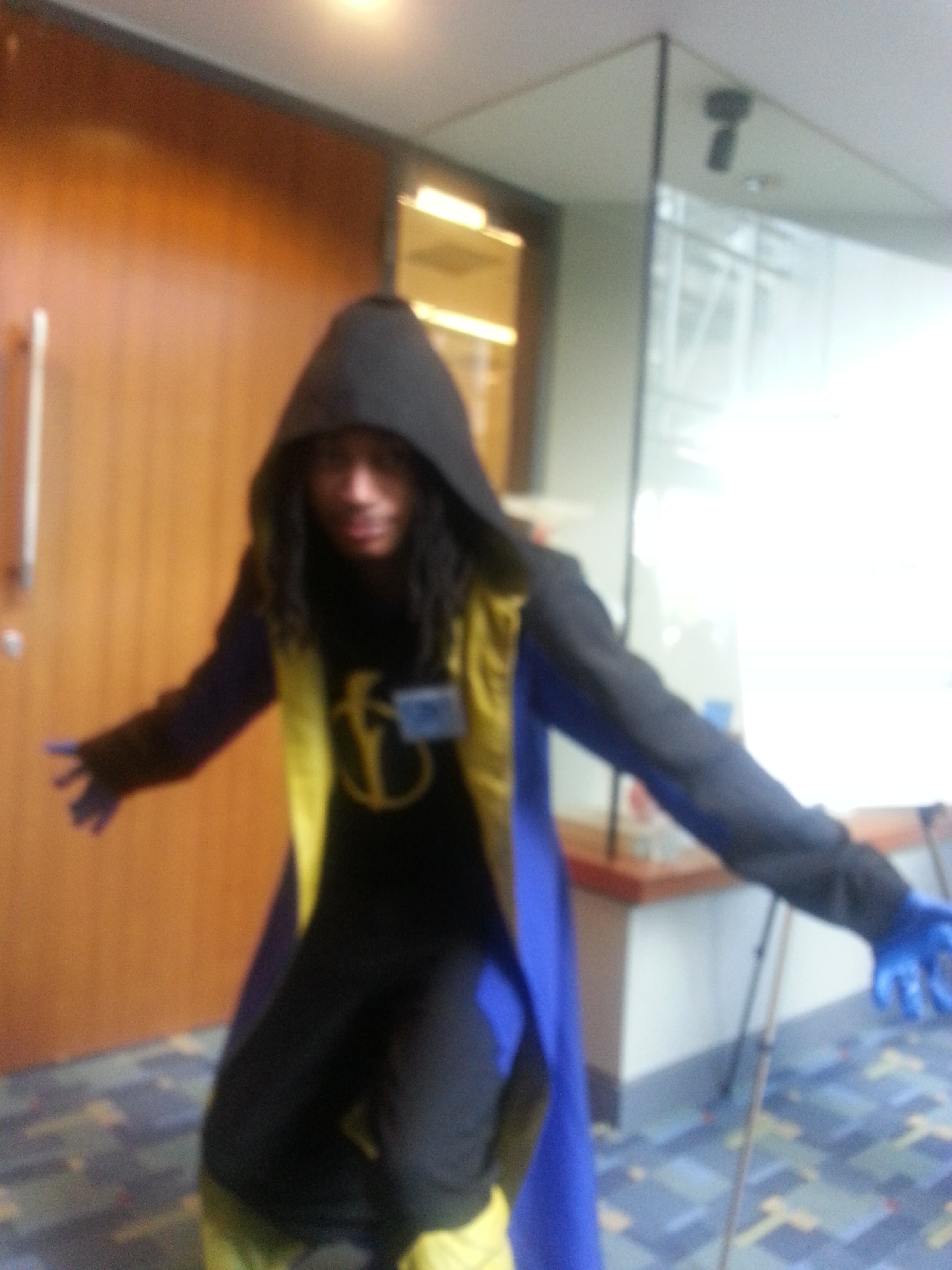
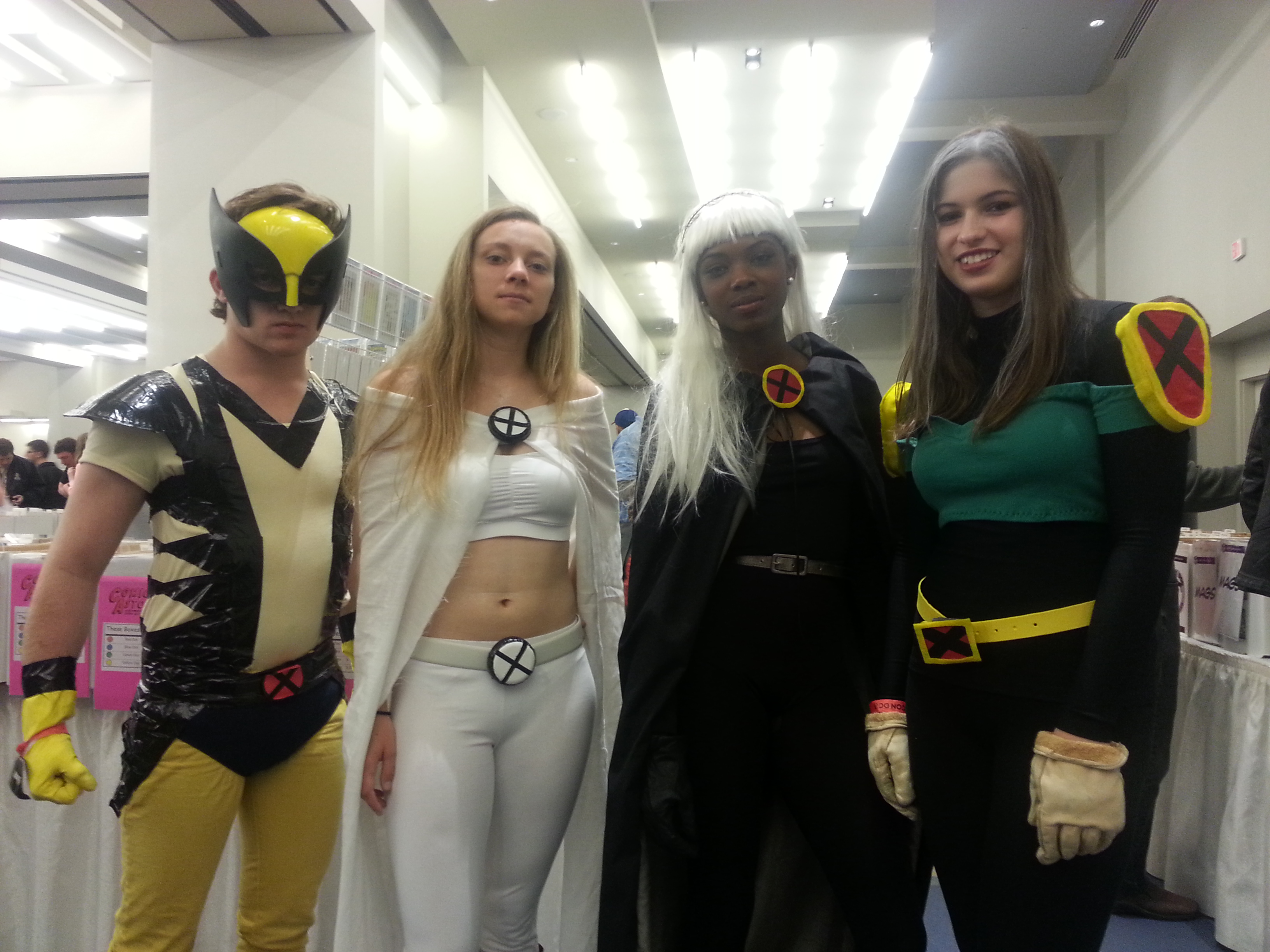
I didn’t take a lot of pictures this year; actually, I didn’t expect to see so many good costumes around at a first-time convention. I did take two, though — my favorites not because they were so “authentic,” but rather because I’ve never seen either a Static nor an X-Men: Evolution cosplay before. In fact, the young lady cosplaying as Evo Rogue was delighted that I even recognized the source material. Static unfortunately turned out blurry, but that was probably his electricity powers interfering with my camera.

20130420_152720 20130421_134613

Note: the Wolverine and Emma Frost pictured here are from Wolverine and the X-Men; Storm and Rogue are from X-Men: Evolution.