Category: Writing Tips


Tomorrow night, I’ll be on a Google Hangout with the other editors and writers who worked on Fate Core. Unfortunately, I don’t have a link to give you. I’ll update this post when I know.  The hangout is supposed to take place at 9pm Eastern.

Edit: And just after posting, I get the link. Come on by!

One more thing!

Always listen to Uncle!

Who says you can’t learn anything from a Saturday morning cartoon? Uncle’s timeless advice always pops up when I get excited about research. (Mind you, it’s usually accompanied by the mental image of an old man whacking me on the side of my head with two outstretched fingers.)

And yes, research can be exciting. If you’re not eager to learn new things and insert them into your craft, you’re probably in the wrong business. Not all research is fun, of course — but from the number of authors and editors I see who share things they find on social sites, it’s fairly obvious that I’m not the only one who likes finding new things.

And I not only enjoy it, but I’m actually good at it, which is why it’s one of my offered services to authors and publishers . . . and one that a lot of people take me up on.

Someone tried taking me to task on that at Balticon, though, claiming that it’s not the job of an editor to do research for an author. Aside from the fact that I get paid for it in addition to more traditional editorial services, I had to explain to him why he’s wrong. And while I’ve talked about the importance of consulting experts already, I figure I ought to give another concrete example.

Almost exactly one year ago, I brainstormed out a YA contemporary fantasy series (The Chronicles of the Ruahim) with my friend and sometime client Regina Doman, and that series is currently coming together. For the sin of coming up with the idea, I’m the managing editor and (technically) senior author on the series. Since it deals with myths all around the world, I find even my childhood fascination with comparative mythology can’t keep up, and I’m constantly doing more and more research on different cultures, different creatures, and different versions of particular legends. Apache, Irish, Norse, British, French, German, Polish, Russian, Jewish, Egyptian, Arabic, Indian, and Japanese have all come up in the context of this series, and we’re just getting started. It also means we have to find words in various different languages, sometimes all for the exact same creatures and concepts.

That’s only part of it, of course. The first book deals with sword techniques, (Irish, Norse, and German techniques, plus modern foil as well), and while I’m pretty knowledgeable on the subject of “real” swords, I know I can always learn more; and of course, I’ve never formally studied fencing, but fortunately I have a good friend who actually teaches it.

The second book (being co-authored by Elizabeth Hausladen of Confessions of a Seamstress) in the series takes place entirely in Paris, which means a lot of research into more mundane matters: maps of the city, Parisian habits, art history, Versailles, the French Revolution, and even life in a convent.

The man who tried telling me off for doing research for an author has obviously never done a typical book project before. I’ve talked before about how an editor is concerned with more than just grammar; an editor’s job is to make the book as high-quality as possible in the time available. That means fact-checking, because you never want your book to contain an error so egregious that experts and knowledgeable amateurs alike will find themselves just talking about what you got wrong.

What I just described for The Chronicles of the Ruahim is merely the most obvious research topics, and only what’s come up so far.  It’s too much for one person. I’m not even talking about the man-hours here; the person doing the research has to process it, translating it into what is necessary to tell the story correctly. Time isn’t so much a factor here as just dealing with all the mess of information that pours in once you open the research floodgates.

Sure, you as an author need to do your own research, but the editor’s job is — among other things — to make certain your work is consistent. If you’re lucky enough to have one already, or you’re willing to hire a freelancer like myself to help out, do it. No one person can do it all alone.

One more thing: listen to Uncle!

Worth Doing Badly

I’m sitting here contemplating my pyrographic habit. (No, no, no, pyrography. I know it looks like another word, but . . . oh, just click here to find out what it is, or here to see way better art than I can do, and here if you want to try it for yourself.) I’m not a very good artist, but wood is a wonderful medium and I enjoy it. In fact, it’s my second-favorite art hobby, and gets less eyebrow-raising than plastic bricks (even if it means I get invited to display at the National Air & Space Museum multiple times; yes, that’s me making a cameo in that article). [EDIT: the article on the other side of that last link no longer quotes me or talks about Lego, but still shows my space shuttle display in the picture.)

Hmm. I might have gone overbudget on links there.

Anyway, I tend to stress about what I work on sometimes. It doesn’t come out perfectly. I don’t have the steadiest hands, or the best skill. I get frustrated when comparing myself to other pyrographers, or even my friends who (while working in more traditional mediums) still outshine me effortlessly. I woke up today feeling discouraged about my talents.

And then, I managed to drag myself out of it.  Continue reading

ACDClogoOver the past weekend, I attended AwesomeConDC, the first genre/comic convention in the Nation’s Capitol. It was an interesting mix of both small and large; it’s the first year for this particular location, but it’s part of a regional franchise . . . which meant that while it was small, it still thought big. This one’s definitely going to grow.

I got involved in the con because the organizer, Ben Penrod, was looking for someone to do a panel on Harry Potter. I’m a (casual and kind of infrequently-attending) member of a local Harry Potter fan club, the DADA (or “Defense Against Dumb A’s”), and when he posted on our message board I mentioned I had experience with public speaking, speaking at cons, and moderating panels to boot. I also have a passing familiarity with the given topic. (Read: I did my thesis on Harry Potter.) 

Ben invited me to give a presentation on writing, and was originally going to have me moderate a novelists’ panel. The wound up getting cancelled, and the second was given to someone else; and when I showed up to moderate the panel on Harry Potter, no one actually showed up for the other seats.

A bit of a mess, yeah. Not really the con’s fault, though; in addition to the craziness that happens with organizing any convention, they wound up with more programing than expected and had to cut something; and the other panel actually already had a moderator, but Ben just didn’t know at the time. And even though a panel on Harry Potter turned into just me babbling on the subject and taking audience questions for fifty minutes, the audience was very kind and didn’t throw a single tomato. And it was a much larger crowd than I’d expected, considering I was competing with Futurama actors next door.

The original topic was going to be (quoting from the program): “Why is the world of Harry Potter so engaging? Is it just the story we read, or is there something more to it, something more enduring that sparks the imagination?” We discussed the purpose of fantasy in the larger culture, what benefit we get from it, why some stories are so engaging, why reboots are common right now, and so on. I got questions on Harry Potter, fantasy languages, Percy Jackson, dropping clues for attentive readers, and a bunch more on writing and editing in general. And for the first time in my public speaking experience, I was unable to get off the stage before people were already asking post-event questions.

Oh, and one young lady wanted to be certain of the exact spelling of G. K. Chesterton’s name. I’d call that one a win.

Ben sent me an email during the talk: “You are awesome. I am so sorry this didn’t go as planned. We will do something great next year. Anything you want, and we will plan WAYYY ahead.” I must say, I’ve never been booked a year in advance, and I’ve never been given carte blanche. I’m all giddy. 😉

So in other words, while I was stressing about not having enough people for a full panel and then discovered that no one else showed up, it turned out pretty well. I had fun, and I’m very glad that AwesomeCon wants me back.

The convention itself is very much centered around comics, and the only reason it didn’t have an Artists’ Alley was because it was kind of hard to tell where to stash it — about a third of the dealers’ room was comprised of artists of various kinds, and they were doing a pretty brisk business. This seems to be an excellent low-overhead con for small-name artists who are dipping their toes in the convention scene. As I said, this convention is definitely going to grow; the space they had was full to bursting, and I suspect they’ll double that next year.

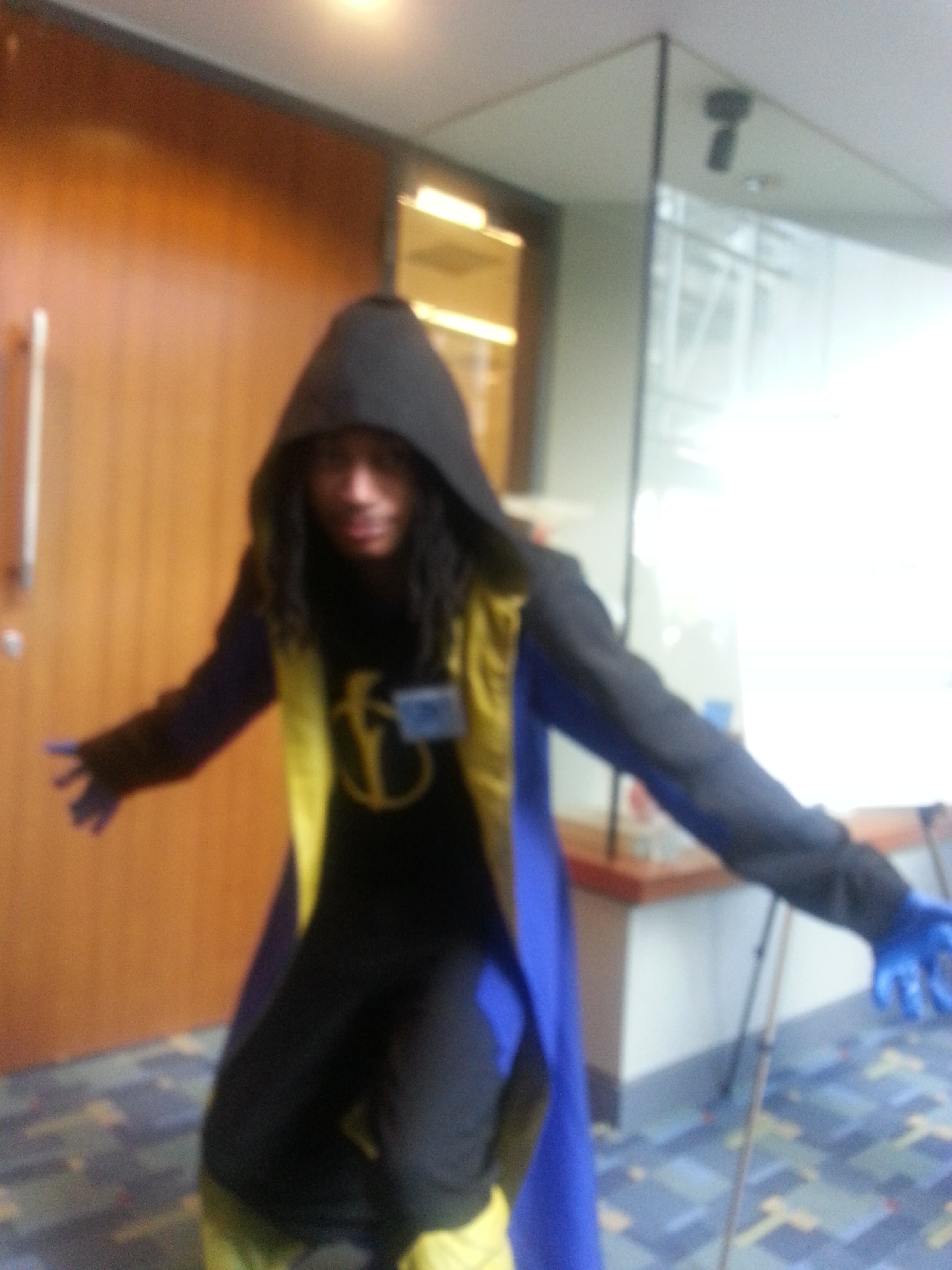
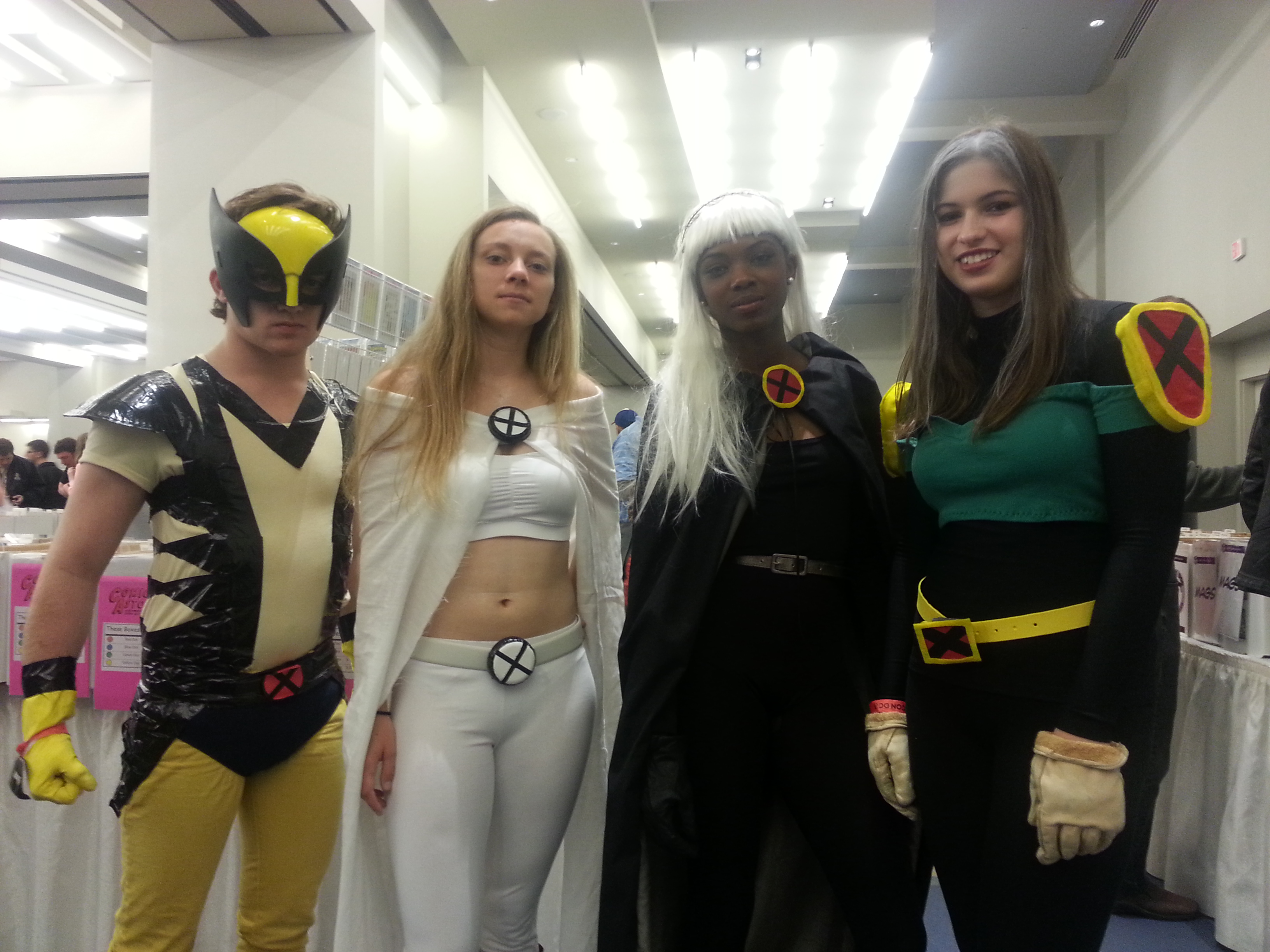
I didn’t take a lot of pictures this year; actually, I didn’t expect to see so many good costumes around at a first-time convention. I did take two, though — my favorites not because they were so “authentic,” but rather because I’ve never seen either a Static nor an X-Men: Evolution cosplay before. In fact, the young lady cosplaying as Evo Rogue was delighted that I even recognized the source material. Static unfortunately turned out blurry, but that was probably his electricity powers interfering with my camera.

20130420_152720 20130421_134613

Note: the Wolverine and Emma Frost pictured here are from Wolverine and the X-Men; Storm and Rogue are from X-Men: Evolution.

Four things you can learn about writing from Soulless:

  1. Regency/Victorian stylings. If you want the feel of 19th century England, it’s obvious where to go: Jane Austen, Charles Dickens, and other authors who lived in that period. Sometimes, though, it’s refreshing to look at someone taking that period and messing around with it, allowing you to see what’s essential and what isn’t. If inserting vampires, werewolves, and ghosts into everyday Victorian society isn’t “messing around with it,” I don’t know what is. 
  2. Sexual humor without vulgarity. It’s a fine line between joking about sex and being crude. There is a lot of sexual humor in this book, but it is funniest when couched in Victorian speech patterns and indirect phrasing. See what you find funniest, and ask yourself why.
  3. Floating perspective. There’s a reason why floating perspective is frowned on in modern fiction: it can get hard to keep track of which person you’re supposed to identify with. It works in Soulless mainly because the literature of the real-life period did it; but to make it work, you have to avoid getting too deep into one character’s perspective before shifting into another’s. Pay attention to where the POV shifts in the middle of a scene, and why Carriger keeps it from being jarring.
  4. Avoid infodumping. Read the first chapter and identify the information that is just placed there before it’s truly needed. Compare this to other parts of the book where information is not given so quickly. How would you rewrite the first chapter to give a steadier, more gentle flow for information? 

There are books on my shelf written by a man with two names. Those names are David Wolverton and David Farland.  Why he publishes under two names is irrelevant to this post. What is relevant are these facts:

  1. He’s good.
  2. He’s entertaining.
  3. He’s an excellent teacher.
  4. His son is currently in the hospital, fighting for his life.

Yeah. Heartstrings are tugging. Continue reading

World Book Day

So apparently today is World Book Day. I’ve actually never heard of this celebration, but hey — books! Anything to make my profession and obsession sound more legit! 😉

Celebrate by reading a book. Or writing one. Or, in my case, editing one! Oh, wait, that’s work. Good thing I love my job.

Consult the Expert

I’m woefully behind on my planned blog posts — which is potentially a good thing, since I’ve been too distracted by editing to write about it. Right now, I’m taking a moment between emails to put down a few thoughts.

Odds are that whatever you write about is, to some extent, outside your area of expertise. No one person can know everything about every subject. To paraphrase G. K. Chesterton, your job as a writer is to get your head into the heavens; if you try to get the heavens into your head, your head will explode. Continue reading

I Am Not the Novel Ninja

No, this is still your same friendly neighborhood editor — I haven’t been hacked, and this isn’t a guest blogger. (Though I might have guest bloggers in the future.) No, the point I want to make today is that I don’t call myself “the Novel Ninja.” I am, at most, a novel ninja. Continue reading

In a bit of irony, one of the first things I did this morning was explain the “fair use” element of US copyright law to an author friend of mine. The same explanation got forwarded to another author friend who wanted more information on the same subject. That will probably get put into a future blog post as well.

For now, though, the irony: in the same day, we’ve had a sudden trend in people posting about “space marines.” It’s trending on Twitter, splashed on Facebook, and circled on Google Plus. But what’s going on? Continue reading