
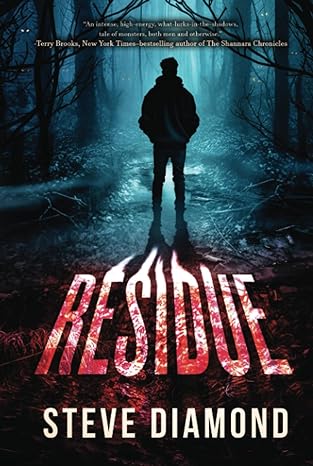
I do not typically enjoy horror stories.
It’s been that way for a long time. Movies and novels alike; I just haven’t enjoyed horror. I don’t edit it either, because I don’t understand it well enough as a genre to give someone an acceptable return on their money. To edit something properly, you have to understand its context and audience; and to do that, you have to enjoy stories like it. Never go to someone who doesn’t enjoy your kind of story.
Oh, I’ve enjoyed an occasional entry in the genre, most notably Dan Wells’ I Am Not a Serial Killer (which was made into a very good low-budget movie, which can be enjoyed on its own even though the book is better); and I greatly appreciated the explanation of horror that Steve Diamond gave way back at the start of the WriterDojo podcast (in their thirteenth episode, appropriately enough). But overall the genre just didn’t speak to me.
Which means, despite getting to know Steve Diamond (online and for a brief meeting in person), I have had absolutely no interest in reading his debut novel, Residue, because it’s primarily supernatural horror. Now, though, after many years, I finally felt like I owed it to him to at least try the book. So when the book was re-released with an audio edition, I bought it and started listening.
I confess, I was almost hoping that the narrator wasn’t good. I’m a self-described audio snob, especially on fiction, and doubly so on high-tension stories (to include horror) because most narrators just don’t get that element. Yes, I was hoping for that, because somehow in my head it was easier to tell Steve that I didn’t like his narrator rather than I didn’t like his book. And I was so certain, because of my past experience with horror, that I wouldn’t like his book.
Fortunately, both were good. Excellent, in fact. I do occasionally enjoy the feeling of being wrong, which is why I’m calling myself out for having prejudged a book I turned out to enjoy.
Residue has been rewritten a few times. There’s a short description of Steve’s publishing woes at the end of the book, and anyone who’s been listening to the WriterDojo knows even more (and you’re all listening, right?). It was originally YA, but in its current edition the two POVs are now cast as college students. The both have special powers, with Alex (Alexandra only if she doesn’t like you) being a telepath and Jack having ESP. Yes, ESP and telepathy are two very different abilities in this magic system . . . but frankly, I enjoyed how said magic system was introduced and I don’t want to spoil it much more than what’s already on the back cover. The short version is that Jack can see and interact with psychic residue from strong emotions and abilities.
While the focus of the story is on Jack’s power, I really want to call out the description of telepathy here as something very good and detailed. Most of the time, telepathy is just handwaved — it sees all, knows all, and its weakness (when it has one) is the inability to turn it off. Steve Diamond takes it a bit farther, giving Alex some real obstacles in getting clear pictures from the minds of others — not the least of which being that she can’t read memories, only surface thoughts. That even includes being unable to “hear” the other side of a telephone conversation unless the person she’s with is deliberately repeating the words of the caller in his mind.
The difficulties of telepathy are also reflected in the narration style. While Jack’s POV is narrated in first person, Alex’s is in third. The book mentions a few times how uncertain she is about her own likes and dislikes, even her own personality, because of how much she picks up from others; Steve mentioned once on the WriterDojo podcast that her third person narration is intended to reflect her lack of confidence in her own sense of self. Knowing that going in, I thought perhaps it would feel jarring, but the opposite was true and the POV switches felt completely natural.
It also served as an interesting counterpart to Alex’s extreme competency. Steve mentioned in his afterword that he was tired of horror-genre damsels in distress, and deliberately made his female lead into a hyper-competent individual, more comfortable with guns than people. I say it’s a counterpart because it’s mentioned several times how she’s grown up knowing all about the hidden world of monsters and powers, grown up as a telepath, and is completely used to it; and yet she has no clue how everyone is influenced by those around her and she shouldn’t be afraid of it when it comes to her own tastes in music or movies. She sees everything in everyone’s heads, to the point of being utterly cynical about how everyone lies; and yet she can’t see the forest for the trees. She knows what people are thinking, but she doesn’t actually know how people think. I’ve never seen telepathy treated so well and so well-rounded in any story before.
When it comes to the horror aspects — as you might expect from the way I started this review — I was pleasantly surprised. I’m used to horror stories with fairly shallow characters and undeveloped settings, punctuated by loving detail on pools of blood, scary sounds, shadows barely seen, and so on. Residue has that kind of thing (and more, when you add in the psychic impressions of extreme violence, which is a very clever narrative device), but I was about two-thirds of the way into the book when I finally realized why I don’t like horror, but I like a book like Residue or I Am Not a Serial Killer.
Almost all horror I’ve encountered before has been focused on helplessness, on the theory that good horror can’t be horror if you can’t be scared of it, and that you can’t be scared of it if you can’t fight it. And yet one of the most successful horror movies of all time, Aliens, stars a bunch of hyper-competent people in a situation where the monsters aren’t immune to bullets as long as you aim (and maybe, just maybe, conserve ammo). The Colonial Marines get their asses handed to them, but not because they’re helpless. They got cocky and were slow to adapt, with even Ripley not sure exactly what they were getting into at first — despite her being the only one who fought a xenomorph and lived, and is the opposite of cocky about the situation.
Steve Diamond managed to hit that Aliens-level feel of competency in the face of overwhelming dread. Even though Jack is thrust into a hidden world of monsters and conspiracies that feels like a Why Files marathon come to life, he rises to the challenge and rapidly develops his powers. Alex, who’s been raised for exactly this sort of situation, still has her own character growth as she, who knows what everyone is thinking, learns to trust someone else. Even when the characters engage in a horror movie cliché, you know exactly why they’re going into that dark hallway with no backup. It makes sense and isn’t forced for Plot Reasons.
I can highly recommend Residue to anyone who enjoys dark urban fantasy, CIA experimentation conspiracy stories, stories where the main characters run toward danger but aren’t stupid about it, and the idea that horrific monsters with a taste for human life still can’t hold a candle to the human capacity for darkness. In other words, if you like Monster Hunter International, The X-Files, and Aliens, and like to occasionally binge episodes of The Why Files, you’ll like Residue.
And as for the audiobook, considering my snobbishness? I recommend putting Tim Campbell on 1.2x speed, but other than that he did an excellent job of conveying intensity, dread, and anticipation throughout the novel. I’d listen to this book again.
(Please note that the links in this post may include Amazon Affiliate codes.)


2 Trackbacks / Pingbacks for this entry:
[…] is the sequel to Residue, which I reviewed previously. After the events of the last book, Jack Bishop has been relocated to Sacramento as part of an […]
LikeLike
[…] to get someone else’s perspective. This week, I was able to ask Steve Diamond, author of Residue and Parasite (among others I haven’t yet reviewed) about his writing career, the nature of […]
LikeLike