
As I mentioned before, I have a few phrases of advice regarding creative writing that I repeat often enough to dub them maxims. This time, I want to look at the concept that real life has an advantage over fiction: fiction has to make sense.
This is hardly an original observation of mine, of course; Mark Twain wrote the first known version of this line (“Truth is stranger than fiction, but it is because Fiction is obliged to stick to possibilities; Truth isn’t”), though I’m rather more fond of G. K. Chesterton’s version (“Truth must of necessity be stranger than fiction […] For fiction is the creation of the human mind, and therefore is congenial to it”).
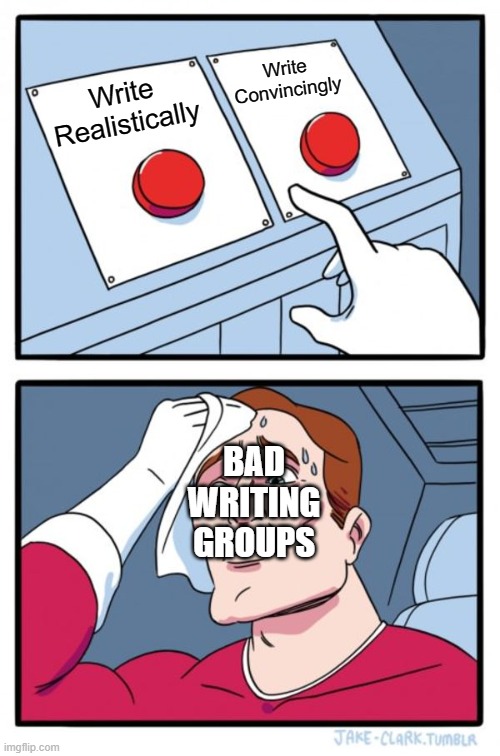
The principle here is that reality can be random, but fiction has to have structure. We strive to make fiction as realistic as we can, but the human mind tends to rebel at a story with too much chaos. Perhaps it’s as simple as a recognition that if humans build something, it should be built with purpose and design, and so something that feels too realistic in this way feels as though the writer was careless.
Whatever the reason, it exists and good authors keep it in mind when they write. Some degree of realism in fiction is absolutely essential, of course; but how much depends on genre, tone, style, and the reaction the author wants to promote in the audience. Beyond that point, whatever it might be, reality doesn’t help much when telling a story, because reality doesn’t need justification; it just exists. Whether something is truly random or not doesn’t matter for most people because it just looks like coincidence most of the time, and it happens so often that we just shrug it off and move on.
But fiction doesn’t work like that. We want our stories to make sense, and when things are too coincidental we tend to rebel. There’s a really bad fantasy war story I commonly use as an example for this concept (no, not one I edited).
In this story, the heroes have finally beat back the armies of the Evil Overlord to his island fortress, where his most loyal followers are ready to fight to the death. Every man, woman, and child participates in the defense. The story pumped this up so much that the author got backed into a corner, with no way for the good guys to win.
So the author just produced a magical superweapon, harnessing the power of the sun, from out of nowhere, with no setup except what got effectively retconned after it was used. The Evil Overlord promptly surrendered, despite the objections of his own generals, and his people lay down their arms with no appreciable resistance. The good guys won with no further effort.
Bad writing, right?
Except this wasn’t a fantasy war story, and it wasn’t some magical weapon. That’s the end of World War II, using previously-secret nuclear weapons that convinced the Emperor of Japan to surrender — despite his generals attempting to assassinate him before he could issue the surrender by radio. (And no, he wasn’t an evil overlord, though the same can’t be said for many who fought in his name.) In the interests of giving credit where it is due, at least partially, I didn’t come up with this comparison but the original appears to be gone from the Internet and I can’t link to it.
It is, of course, an extreme example; but it shows how and why a story element can fall flat when justified by saying “That’s how it worked in reality.” We expect stories to live up to a higher standard. They’re built on top of reality, and so need more structure than our own chaotic lives.
Writing a story that introduces the equivalent of the first nuclear bomb also requires you to introduce the equivalent of the Manhattan Project, or it’s not set up. The bigger the shift or twist, the more support it needs for the audience to look back on — even if they didn’t put the pieces together until the last moment. Even then, it has to work within your worldbuilding. In the real world, we just accept that nukes work, but in fiction we need to know what makes special things special — at least enough to understand that they are fueling the plot. We don’t need to know the physics behind the starship drive or how hot the wizard’s fire is in Kelvin; we just need to know if either one is ordinary or unusual, and if it’s the latter then we need to have story-based (and not necessarily physics-based) justifications.
Explaining it through story means more than just setting up your magic or advanced tech system (but I repeat myself). It’s important to show that it still requires effort, or there’s no drama; if there’s no effort involved, then it’s just something we use to get to the actual drama, rather like in an Indiana Jones movie where long-distance travel happens via a red line on a map.
This becomes useful as a tool for supporting said drama, as more you show skill and effort on the part of the protagonist to overcome obstacles in his or her way, the more you can sneak in coincidence because it still feels like everyone worked for it.
For example, in the urban fantasy series The Dresden Files, there exist certain people who wield swords forged with the nails of the True Cross (that is, the nails that were used to execute Jesus Christ). These are the three Knights of the Cross, and while they don’t have power like a wizard apart from their swords, we’re frequently told that coincidence tends to bend to their favor. If God wants them to be in a particular pace, they will be, even if it means they missed a flight on the way back from another mission and therefore had to rent a car. Stuff like that. But even though the first Knight we see is in book three, it isn’t until book eight that we see that coincidence-bending happen in the titular Harry Dresden’s favor. Even then, it was set up in detail, with Harry effectively provoking the ability, so it doesn’t feel like coincidence on the part of the reader.
The first time that happens in the whole series — the first time one of the Knights does something purely convenient — is in book twelve, when a building is burning down and an incidental character, one of the elderly residents Harry is rescuing from the fire, prays out loud for help . . . and a Knight comes vaulting over the fence into the yard to help carry people to safety. And since we’ve just had effectively nine books of setup at this point, it’s kind of unfair to call that unsupported by the narrative. It also has very little effect beyond the immediate scene, as Harry was already in the process of helping people out. In effect, while it feels like the scene was self-contained, the real purpose of it (beyond, well . . . spoilers) is to justify the Knight being around for what happens next.
If you want to put this concept into a lofty-sounding principle, it would be: The protagonist can benefit from coincidence in direct proportion to their effort and skill, and in inverse proportion to how it affects the protagonist’s larger goals. You want your characters to work for it; but the more they work for it, the more they can benefit from lucky breaks. That way the audience understands that the character is competent, and that it’s not just a deus ex machina that allowed the protagonist to be in the right place at the right time.
The reverse, however, is not always true: Problems can, and often do, show up out of the blue for your protagonist, as long as it is merely plausible. To look at another wizard named Harry, Draco Malfoy causes problems for the three main characters in the first Harry Potter book when he catches them out of bed after curfew. We don’t need an explanation for how he happened to spot them; it’s merely enough that it’s plausible. Meanwhile, any time Harry and his friends catch someone being suspicious, we have to have an explanation as to why they were there to witness it.
Once you start noticing this, you’ll see it everywhere in good books: many situations where circumstances are stacked against the protagonists in ways that defy probability, and yet it feels palatable as long as their advantages are properly set up.
 Novel Ninja
You must be logged in to post a comment.